Central Residency Scheme – Doctors, Duty and Rights
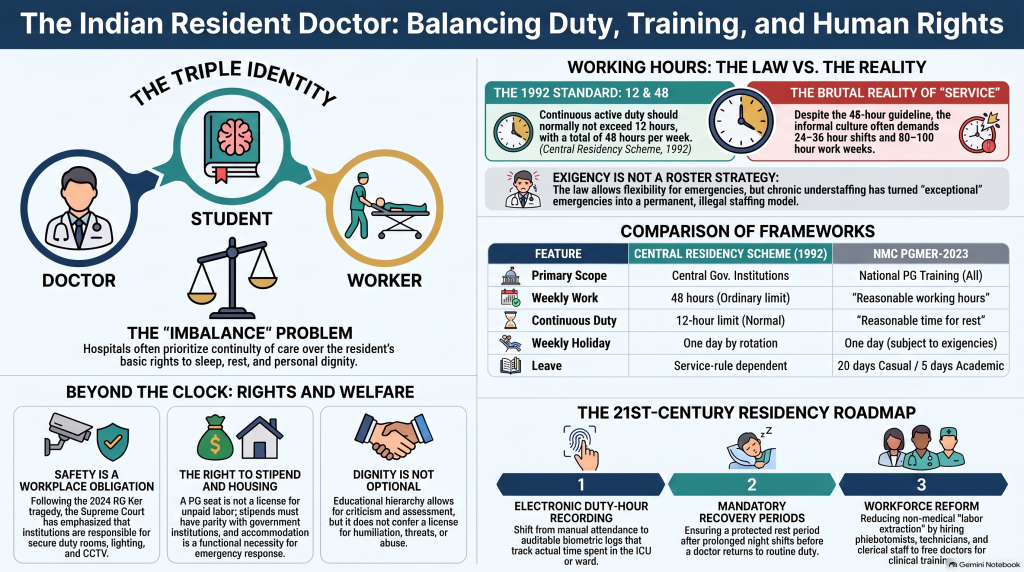 Central Residency Scheme – Doctors, Duty and Rights
The Indian Resident Doctor Is a Doctor, Student and Worker at the Same Time
Residency is one of the peculiar institutions of Indian medicine. A postgraduate resident is simultaneously a qualified doctor treating patients, a trainee acquiring specialist competence, an academic expected to study and conduct research, and a workforce member on whom much of a teaching hospital depends.
This hybrid status creates an obvious imbalance. Hospitals require continuity of patient care. Residents require sufficient clinical exposure to become competent specialists. But neither objective requires unlimited working hours, sleep deprivation, humiliation or the assumption that a postgraduate seat suspends ordinary rights to health, rest and dignity.
India has, in fact, had a framework governing residency for decades: the Central Residency Scheme. Its origins go back to the 1970s, with its important consolidated version issued by the Ministry of Health and Family Welfare on 5 June 1992.
More than three decades later, the scheme has unexpectedly become highly relevant again. Excessive resident duty hours have reached the Supreme Court, the National Human Rights Commission has intervened, the National Medical Commission has examined resident well-being, and the Union Government has begun reviewing the 1992 scheme itself.
The central question is no longer simply:
How much work should a resident doctor do?
It is:
What is the legitimate balance between a doctor’s duty to patients and the institution’s duty to the doctor?
What Is the Central Residency Scheme?
The Central Residency Scheme did not suddenly appear in 1992.
On the recommendations associated with the Kartar Singh Committee, the Government of India introduced a structured residency system from 1 January 1974, replacing older categories such as house surgeons, postgraduate students and registrars in Central Government institutions and hospitals. It created the familiar two-tier structure of Junior Residents and Senior Residents. The scheme was subsequently reviewed, and consolidated instructions were issued by the Ministry of Health and Family Welfare through letter S-11014/3/91-ME(P), dated 5 June 1992.
The residency model therefore had a larger purpose than merely deciding working hours. It attempted to standardise:
- designation and recruitment of resident doctors;
- Junior and Senior Residency;
- tenure;
- remuneration and allowances;
- accommodation;
- duties and responsibilities;
- working hours;
- weekly holidays; and
- conditions of service.
The scheme continues to have practical relevance. Even in 2025 and 2026, Central Government institutions and other public hospitals have advertised Senior Resident posts specifically under the Government of India/Central Residency Scheme.
Is the Central Residency Scheme Applicable to Every Doctor in India?
This is where an important legal distinction is necessary.
The expression “Central Residency Scheme” is sometimes used as though the 1992 document were automatically a national labour statute covering every resident in every government and private medical college.
That is an oversimplification.
The original scheme directly concerned Central Government hospitals and institutions, including specified statutory or autonomous institutions financed by the Central Government. Government records have historically acknowledged this scope. States and institutions have subsequently adopted, adapted or referred to the scheme in different ways.
Today, however, another layer exists.
The National Medical Commission’s Post-Graduate Medical Education Regulations, 2023 — PGMER-2023 — are national medical-education regulations governing recognised postgraduate medical training. They independently prescribe standards relating to residency, working hours, rest, stipend and leave.
Therefore, when discussing resident doctors’ rights in 2026, three different sources must not be confused:
| Framework | What it does |
|---|---|
| Central Residency Scheme, 1992 | Sets service conditions for the residency system, particularly important in Central institutions and institutions that have adopted it |
| NMC PGMER-2023 | Regulates recognised postgraduate medical training nationally |
| State/institutional service rules | Determine several practical conditions of appointment, pay, leave, accommodation and administration |
In addition, constitutional protections, employment law, anti-ragging rules, disability law, sexual-harassment law and ordinary criminal law continue to apply.
Being a resident doctor does not create a law-free zone inside a hospital.
The Most Important Provision: Duty Hours
The provision that has attracted the greatest attention is Paragraph 13 of the 1992 scheme.
It states, in substance, that:
- continuous active duty should normally not exceed 12 hours per day;
- resident doctors should be given one weekly holiday by rotation, subject to exigencies of work;
- on-call duty should not exceed 12 hours at a time; and
- Junior Residents should ordinarily work 48 hours per week, with flexibility based upon workload and availability of doctors.
The Delhi High Court reproduced these provisions while considering the Central Residency Scheme in Resident Doctors Association v. AIIMS.
These numbers are remarkable when compared with the informal residency culture that subsequently developed in many institutions.
A 24-hour duty followed by morning rounds is not 12 hours.
A 36-hour emergency duty is not 12 hours.
Seven consecutive working days without a weekly off are difficult to reconcile with a scheme expressly contemplating a weekly holiday.
And an 80–100-hour work week is very different from the scheme’s stated ordinary limit of 48 hours for Junior Residents.
But What Does “Normally” and “Ordinarily” Mean?
This is an equally important part of the discussion.
The 1992 wording does not say:
Under no circumstances may a resident ever work beyond 12 hours.
Medicine necessarily includes emergencies. Major disasters, mass casualties, sudden staff shortages and unstable patients cannot always be fitted into a roster.
The scheme itself therefore uses expressions such as:
“normally,” “ordinarily,” “subject to exigencies of work,” and provides some flexibility to hospital administration.
But an exception cannot logically become the routine.
A genuine emergency requiring a resident to stay beyond scheduled duty is fundamentally different from designing every unit roster around routine 24-, 30- or 36-hour shifts.
“Exigency of work” should describe an exceptional clinical situation — not a permanent staffing model.
If every Monday is an exigency, it is no longer an exigency. It is workforce planning.
NMC’s 2023 Regulations: “Reasonable Working Hours”
The National Medical Commission revisited the issue indirectly in the Post-Graduate Medical Education Regulations, 2023.
PGMER-2023 states:
“All post-graduate students will work as full-time resident doctors.”
It then requires them to work for reasonable working hours and to receive reasonable time for rest in a day.
This is important because it formally recognises that postgraduate education does not justify unrestricted duty.
However, the regulation creates another problem:
What exactly is “reasonable”?
Eight hours?
Twelve?
Sixteen?
Twenty-four?
The NMC regulation does not specify a numerical ceiling.
That ambiguity is one reason the old 1992 framework has returned to prominence.
The Strange 48-Hour Versus 74-Hour Debate
The issue became even more complicated after the NMC’s National Task Force examined the mental health and well-being of medical students.
The Task Force acknowledged that the 1992 Government guidelines envisaged approximately 48 hours per week and no more than 12 hours of continuous active duty. It also acknowledged that these standards had not been widely implemented, citing workforce and logistical constraints.
The Task Force subsequently proposed, as a feasibility-based recommendation, a schedule of no more than 74 hours per week and no more than 24 hours at a stretch, together with one day off per week.
That recommendation should not be confused with a statutory amendment converting 74 hours into India’s legal residency limit.
It illustrates the central policy conflict:
The humane standard
48 hours per week with limited continuous duty.
versus
The health-system reality
Many Indian hospitals depend structurally on residents working considerably longer hours.
The solution cannot simply be to redefine exhaustion as training.
Clinical Training Is Not the Same as Labour Extraction
Long residency hours are traditionally defended on educational grounds.
There is some truth in the argument that medicine cannot be learnt entirely through fixed office shifts. Residents must experience:
- night emergencies;
- longitudinal evolution of illness;
- peri-operative care;
- ICU deterioration;
- obstetric emergencies;
- postoperative complications;
- handovers;
- rare procedures; and
- decision-making under real clinical conditions.
Continuity matters.
But educational exposure and unlimited service work are not synonymous.
A resident spending four additional hours discussing a complex case, performing a supervised procedure or managing an emergency is receiving training.
A resident spending those same hours repeatedly drawing routine blood samples because adequate support staff were never recruited represents a different problem.
Residency should contain service.
Service should not consume residency.
Residents Also Have Duties
Any discussion of doctors’ rights becomes incomplete if it ignores doctors’ obligations.
The residency system imposes significant responsibilities precisely because residents participate directly in patient care.
A resident is expected to perform work legitimately required in the interest of patients. Current postgraduate regulations similarly envisage graded responsibility in diagnosis, treatment and management of patients entrusted to residents.
These responsibilities include:
1. Patient care
Residents cannot simply abandon an unstable patient because the clock has reached the end of a shift.
A safe handover must occur.
2. Emergency responsibility
Medical emergencies frequently require flexibility that ordinary occupations do not.
3. Academic work
Residency involves much more than ward duty.
PGMER-2023 expects participation in:
- seminars;
- journal clubs;
- clinical meetings;
- grand rounds;
- research;
- thesis work;
- undergraduate teaching;
- procedural training; and
- maintenance of training records and logbooks.
4. Professional conduct
Confidentiality, informed consent, accurate documentation, ethical prescribing and appropriate supervision remain professional obligations regardless of workload.
5. Handover
A doctor’s right to leave after duty does not mean a patient can be left without continuity of care.
But the institution has the reciprocal responsibility to create a roster in which another rested doctor is available to take over.
6. No unauthorised private practice where prohibited
Residency appointments under Central Government schemes commonly prohibit private practice. Contemporary recruitment notices continue to expressly incorporate this restriction.
The Right to Rest Is Also a Patient-Safety Issue
Duty-hour reform is sometimes presented as doctors demanding a better “work-life balance”.
That framing is too narrow.
Sleep deprivation affects:
- attention;
- working memory;
- reaction time;
- executive function;
- emotional regulation;
- diagnostic reasoning; and
- procedural performance.
The person affected is therefore not only the doctor.
It is also the patient being assessed at 4 AM by a physician who has already been awake and working for more than a day.
The NMC’s own National Task Force recognised excessive duty hours as a threat both to resident health and patient safety.
A rested doctor is not a luxury for the medical profession.
A rested doctor is part of a safe healthcare system.
Weekly Off: A Right That Is Frequently Forgotten
Both older and newer frameworks recognise the concept of a weekly holiday.
The 1992 Central Residency Scheme provides for one weekly holiday by rotation, subject to exigencies of work.
PGMER-2023 independently provides that postgraduate students should be allowed one weekly holiday, again subject to work exigencies.
This does not necessarily mean Sunday.
A hospital operates seven days a week. Different residents can receive different days off.
But the distinction between:
“Sunday is not guaranteed”
and
“there is no weekly holiday”
is substantial.
The former is inherent to hospital work.
The latter defeats the purpose of the regulation.
Paid Casual Leave
PGMER-2023 gives every postgraduate student a minimum of:
20 days of paid casual leave per year.
This is not merely discretionary institutional generosity. It is expressly incorporated into the national postgraduate regulatory framework.
If leave beyond the permitted amount is taken, the training period may be extended correspondingly so that the required period of postgraduate training is completed.
This is a reasonable principle: the doctor receives legitimate leave, while the integrity of specialist training is preserved.
Academic Leave
PGMER-2023 additionally provides:
five days of paid academic leave per year.
Academic leave is important because residents are supposed to become specialists and researchers, not merely provide service manpower.
Conferences, scientific presentations, academic examinations and appropriate professional development are part of postgraduate education.
A system that demands research output while refusing any time for academic development creates contradictory expectations.
Maternity and Paternity Leave
The regulations also recognise:
- maternity leave for female postgraduate students, and
- paternity leave for male postgraduate students
according to applicable Government rules and regulations.
Residency therefore cannot legitimately operate on the assumption that pregnancy or parenthood automatically extinguishes postgraduate rights.
The precise duration and administrative consequences may depend upon the applicable Government rules, university requirements and training-completion requirements.
Right to Stipend
PG residents are not merely conventional students sitting in classrooms.
They render substantial clinical services.
PGMER-2023 therefore contains provisions requiring payment of stipend to covered postgraduate residents with parity linked to corresponding Government medical institutions in the State or Union Territory.
The underlying principle is important:
A postgraduate seat is not a licence for unpaid medical labour.
Where the regulation applies, calling a doctor a “student” does not permit an institution to ignore the work being performed.
The NMC has also required institutions to submit and disclose information relating to stipends paid to interns, postgraduate residents and Senior Residents, reflecting increasing regulatory attention to the subject.
Accommodation: Why Is It Part of the Residency Scheme?
The word resident historically meant something quite literal.
Doctors were expected to remain close to the hospital so that they could respond rapidly to clinical emergencies.
Accordingly, the Central Residency Scheme contemplated free furnished accommodation together with electricity and water within prescribed limits. The provision was examined by the Delhi High Court in litigation involving AIIMS resident doctors.
Accommodation is therefore not merely a perk.
For someone finishing duty at 2 AM and returning for emergency care several hours later, safe accommodation close to the hospital has implications for:
- fatigue;
- travel safety;
- response time;
- personal security; and
- patient care.
The problem remains contemporary. A 2026 Parliamentary committee report concerning AIIMS New Delhi specifically noted shortages of hostel accommodation for resident doctors and said the situation undermined the intent of the Central Residency Scheme.
Does a Resident Get Both Free Accommodation and HRA?
Not necessarily.
This is one area where simplified online descriptions of the Central Residency Scheme can be misleading.
The Delhi High Court considered precisely this dispute in Resident Doctors Association v. AIIMS.
The Court held that residents occupying free furnished Government accommodation could not simultaneously insist on HRA where applicable Government orders excluded HRA for those receiving Government accommodation. Residents who did not avail themselves of the accommodation could receive HRA according to the applicable rules.
Therefore, the correct formulation is not:
“Every resident has an absolute right to free hostel accommodation plus HRA.”
Rather:
Accommodation and HRA must be determined according to the Residency Scheme read with the applicable Government rules and terms of appointment.
Right to a Safe Workplace
The murder of a postgraduate doctor at RG Kar Medical College in Kolkata in August 2024 fundamentally altered the national discussion around resident doctors.
When the matter reached the Supreme Court, the Court treated the safety and well-being of medical professionals at their workplaces as an issue of national importance and constituted a National Task Force to address systemic concerns.
Security therefore cannot be reduced to telling residents to “be careful”.
Institutions have responsibilities involving:
- secure duty rooms;
- adequate lighting;
- controlled access;
- functional CCTV where appropriate;
- safe transport or movement during late hours;
- functioning security personnel;
- separate and secure rest facilities where necessary;
- emergency response systems; and
- effective mechanisms for reporting violence and harassment.
A residency programme that requires a doctor to remain inside a hospital throughout the night must take responsibility for making that environment reasonably safe.
Dignity Is Not Optional
Traditional medical training sometimes romanticises humiliation.
Public shouting, threats of failing examinations, derogatory comments, caste or gender abuse, deliberate sleep deprivation, impossible duty rosters and punishment unrelated to educational objectives may be rationalised as “how residency works”.
That argument has become increasingly difficult to defend.
The educational hierarchy of medicine permits:
- supervision;
- criticism;
- correction of clinical mistakes;
- performance assessment;
- additional supervised training where competence is deficient; and
- disciplinary action through appropriate procedures.
It does not confer a general licence for abuse.
Hierarchy is necessary for accountability. It is not immunity from accountability.
Residents Cannot Demand Rights While Ignoring Patient Rights
The opposite extreme must also be avoided.
Doctors occupy a special position because interruption of medical services can immediately affect life.
Indian courts have repeatedly emphasised that there is no fundamental right of employees to strike, and courts considering medical strikes have placed particular emphasis on doctors’ responsibility towards patients. The Madras High Court, drawing on Supreme Court precedent, held that doctors cannot claim an unrestricted right to strike or boycott clinical work where patient care is jeopardised.
This does not mean doctors cannot:
- form associations;
- make representations;
- protest peacefully;
- challenge illegal conditions;
- approach regulatory authorities;
- seek judicial remedies; or
- demand systemic reform.
It means that collective action in healthcare must account for the immediate rights of patients, especially emergency and life-saving care.
Doctors’ rights and patients’ rights are therefore not competing philosophies.
A mature healthcare system protects both.
The Supreme Court and the “Inhuman” Duty-Hour Question
The issue acquired extraordinary significance in August 2024.
During proceedings following the RG Kar case, the Supreme Court expressed concern about residents working extremely prolonged shifts and reportedly described 36–48-hour stretches as inhuman, asking that working conditions also be examined.
Then, in April 2025, the United Doctors Front filed a petition before the Supreme Court seeking enforcement of humane duty-hour norms.
Among the questions now raised before the Court are:
- whether systematic violation of duty-hour standards infringes Article 21;
- whether the 1992 Central Government residency norms are legally enforceable more widely;
- whether the NMC’s undefined requirement of “reasonable working hours” is sufficient; and
- what mechanism should exist to enforce duty-hour protections.
In August 2025, the Supreme Court issued notice to the Union Government and NMC.
The matter remains pending.
As of August 2026, the Court had not delivered a final judgment establishing a nationwide 48-hour cap. At a hearing on 31 July 2026, the matter was adjourned after the Union Government’s counter-affidavit could not be located in the Court record; the matter was reported as listed for 17 September 2026.
That distinction is crucial.
The Supreme Court is considering the issue.
It has not yet finally declared that every PG resident in every Indian medical college has an absolute judicially enforceable 48-hour work week under the 1992 scheme.
NHRC Intervention
The issue has also moved beyond medical education into the language of human rights.
In April 2026, the National Human Rights Commission issued notice to the NMC and Union Health Ministry over allegations that postgraduate residents, including doctors with disabilities, were being subjected to shifts lasting 24–36 hours and sometimes even longer.
The NHRC described the allegations as potentially raising serious human-rights concerns and sought an action-taken report.
This represents an important conceptual shift.
Excessive duty hours are no longer being discussed solely as a dispute between residents and Heads of Department.
They are increasingly being examined through the lenses of:
human dignity, occupational health, disability accommodation, patient safety and constitutional rights.
The Government Is Reviewing the 1992 Scheme
Another major development occurred on 22 April 2025, when the Directorate General of Health Services convened a high-level meeting to review the Central Residency Scheme after more than three decades.
The discussions reportedly included:
- working hours;
- the proposed 48-hour week;
- hostel facilities;
- salary;
- health benefits;
- thesis-related support; and
- conditions affecting Junior and Senior Residents.
Resident organisations stated that a 48-hour proposal received favourable consideration, but the Director General of Health Services clarified at the time that no final decision had yet been made and Ministry approval was still required.
Therefore, reports that the Government has already enacted a new nationwide 48-hour residency law should be treated cautiously unless accompanied by an actual final Government notification.
Why 24–36-Hour Duties Persist
The uncomfortable reality is that many hospitals have designed their services around resident overwork.
The reasons include:
Inadequate doctor-to-patient ratios
Large government hospitals may receive thousands of patients daily.
Vacant faculty and resident posts
If sanctioned manpower remains vacant, the clinical work does not disappear.
Dependence on PG residents for service delivery
Residents are often the most continuously available doctors in wards.
Poor task allocation
Doctors frequently perform administrative and clerical work that could be handled by other staff.
Inadequate phlebotomy, transport and support services
Highly trained doctors may spend hours performing tasks unrelated to specialist training.
Traditional culture
Many consultants themselves survived extreme residency schedules and therefore unconsciously reproduce them.
Lack of duty-hour recording
If actual start and finish times are never independently measured, excessive work remains invisible.
The answer therefore cannot simply be:
“Residents should work 48 hours.”
A hospital serving the same number of patients with the same manpower cannot magically remove 30 hours of work from every resident.
Real duty-hour reform requires workforce reform.
What a Modern Indian Residency System Should Look Like
The next Central Residency Scheme should move beyond vague promises.
1. Electronic duty-hour recording
Actual working hours should be auditable.
Not merely attendance.
A resident who biometrically reports at 8 AM but leaves the ICU at 11 PM has worked 15 hours, regardless of what the formal roster says.
2. Defined maximum continuous duty
The phrase “reasonable hours” is too vague to protect either residents or institutions.
A clear maximum is needed, with defined emergency exceptions.
3. Mandatory recovery period
The number of hours worked is only part of the problem.
A resident completing a prolonged night shift needs protected recovery time before returning to routine duty.
4. Genuine weekly off
Off-days should be incorporated into rosters rather than granted only when workload happens to be low.
5. Emergency exception documentation
If a resident must exceed the normal limit because of a genuine emergency, the reason should be documented.
Patterns can then be audited.
If “emergency exceptions” occur every week, manpower is inadequate.
6. Protected academic time
Journal clubs, thesis work and teaching cannot simply be added on top of unlimited clinical service.
7. Adequate resident strength
Duty-hour reform without workforce planning merely transfers excessive workload from one exhausted doctor to another.
8. Better allied-health staffing
Phlebotomists, physician assistants, nurse practitioners where appropriate, technicians, clerical staff and hospital attendants can remove large amounts of non-educational work from residents.
9. Safe duty rooms
A doctor required to remain overnight must have somewhere safe and hygienic to rest.
10. Independent grievance mechanisms
A resident should not have to complain exclusively to the same individual who controls:
- duty allocation;
- thesis progress;
- departmental assessment;
- recommendation letters; and
- examination-related academic evaluation.
That concentration of power naturally discourages complaints.
Rights Must Not Become a Battle Against Consultants
Duty-hour reform is sometimes framed as a generational conflict:
Residents versus professors.
That framing is counterproductive.
Most Heads of Department do not create patient loads, sanctioned posts, infrastructure shortages or Government recruitment delays.
If one resident is removed from a 36-hour roster without additional manpower, somebody else must cover that patient.
The real question is therefore institutional:
How many doctors are required to deliver the hospital’s clinical workload safely while simultaneously providing postgraduate education?
That is a workforce-planning problem, not a test of dedication.
Medicine Should Stop Equating Exhaustion With Commitment
There is a deeply embedded belief in medical culture:
“We worked for 36 hours during our residency, therefore today’s residents should too.”
But endurance is not evidence.
Medicine routinely abandons old practices when better evidence emerges.
We no longer defend an outdated treatment merely because previous generations used it.
The same reasoning should apply to medical training.
The purpose of residency is to produce a doctor who can:
- think;
- diagnose;
- operate;
- communicate;
- teach;
- manage uncertainty;
- respond to emergencies; and
- make safe decisions.
Sleep deprivation can undermine precisely those abilities.
A resident unconscious with exhaustion is not receiving more education simply because he or she remains physically inside the hospital.
Duty and Rights Are Reciprocal
The Central Residency Scheme debate is ultimately not about residents wanting to work less.
It is about defining a professional social contract.
The doctor owes the patient:
competence, continuity, responsibility, ethical care and reasonable flexibility during emergencies.
The resident owes the training programme:
study, clinical work, research, teaching, professionalism and progressive acquisition of competence.
The hospital owes the resident:
reasonable hours, safe working conditions, appropriate supervision, rest, remuneration, leave, accommodation where applicable and dignity.
The Government owes the health system:
adequate manpower and infrastructure so that patient care does not depend on chronic exhaustion.
These obligations cannot be separated.
What Resident Doctors Can Reasonably Claim Today
Based on the current regulatory position, a postgraduate resident can confidently point to several established principles:
| Issue | Present position |
| Full-time residency | Required under PGMER-2023 |
| Reasonable working hours | Expressly required by PGMER-2023 |
| Reasonable daily rest | Expressly required by PGMER-2023 |
| 48-hour week | Expressly present as the ordinary standard for Junior Residents in the 1992 Central Residency Scheme; nationwide enforceability is currently under judicial scrutiny |
| Maximum 12-hour continuous active duty | Provided in the 1992 scheme, subject to its wording and applicability |
| Weekly holiday | Recognised under both the 1992 framework and PGMER-2023, subject to exigencies |
| Paid casual leave | Minimum 20 days annually under PGMER-2023 |
| Academic leave | Five paid days annually under PGMER-2023 |
| Maternity/paternity leave | Recognised according to applicable Government rules |
| Stipend | Regulated under PGMER-2023 for covered PG training |
| Accommodation | Important entitlement under the Central Residency framework where applicable |
| Safe workplace | Increasingly recognised as a core institutional obligation |
| Absolute right to strike | No; courts have repeatedly rejected an unrestricted right of doctors to strike where patient care is affected |
The Central Residency Scheme Needs a 21st-Century Rewrite
The 1992 framework was remarkably progressive in recognising a problem India still has not solved more than three decades later.
But modern residency has changed.
Today’s residents work in:
- massive ICUs;
- high-volume trauma centres;
- transplant programmes;
- interventional laboratories;
- sophisticated operating theatres;
- electronic medical-record systems; and
- highly specialised tertiary hospitals that barely resemble those of 1992.
A modern residency framework therefore needs more than a single number.
It should define:
Maximum weekly hours + maximum continuous duty + minimum rest between shifts + weekly off + emergency exceptions + electronic monitoring + protected teaching time + grievance redressal + institutional penalties for repeated violations.
That would convert a principle into a functioning system.
Conclusion: A Doctor’s Duty Does Not Cancel a Doctor’s Rights
Medicine demands sacrifice.
A patient may deteriorate five minutes before a shift ends. An operation may continue longer than expected. A mass casualty cannot wait for the next roster. There will always be moments when doctors must do more than what a timetable requires.
That is part of medicine.
But exceptional commitment is meaningful precisely because it is exceptional.
When chronic understaffing turns every day into an emergency, exhaustion is no longer professional sacrifice. It becomes institutional design.
The Central Residency Scheme recognised as far back as 1992 that residents needed limits on continuous duty, weekly holidays and humane conditions. PGMER-2023 now expressly requires reasonable working hours and reasonable rest. The Supreme Court is examining whether stronger nationwide enforcement is required, while the Government itself has reopened the scheme for review.
India therefore has an opportunity to move away from the false choice between doctors’ rights and patients’ rights.
The two are connected.
A resident doctor deserves training rigorous enough to create an excellent specialist.
A patient deserves a doctor alert enough to think clearly.
A hospital deserves professionals willing to respond when genuine emergencies arise.
And a profession built around preserving human life should not require its youngest specialists to routinely sacrifice their own health and dignity to keep the system functioning.
Residency should be demanding. It should not be dehumanising.
Legal and regulatory note: The Central Residency Scheme, NMC regulations, State service rules and individual institutional appointment conditions operate at different levels. The Supreme Court proceedings concerning nationwide enforcement of resident duty-hour limits remain pending as of August 2026. This article is an educational overview rather than individual legal advice.