Treating Obsessive Intrusive Imagery: Visual and Auditory Experiences
 Introduction
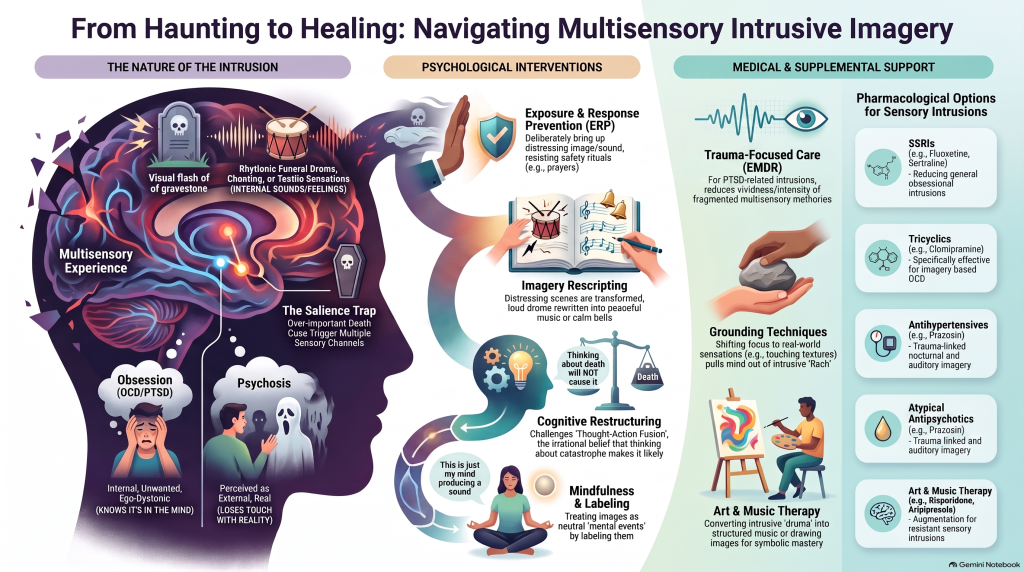
Intrusive mental images are not limited to the visual channel. Many individuals experience them as a multisensory phenomenon—seeing vivid pictures, hearing associated sounds, and even sensing smells or tactile sensations. When these images revolve around death, corpses, and funeral scenes, the distress can be profound.
For example, some people repeatedly picture dead bodies while simultaneously “hearing” the rhythmic drums of a funeral procession. These are not hallucinations (perceived as real external events), but rather obsessional intrusive experiences—ego-dystonic, unwanted, and recurrent.
Such experiences occur most commonly in Obsessive-Compulsive Disorder (OCD) and sometimes in Post-Traumatic Stress Disorder (PTSD), but the treatment principles overlap.
Understanding Multisensory Intrusive Imagery
-
Visual Intrusions:
-
Images of corpses, burial rituals, decay, or coffins.
-
Often described as “flashes” or “stuck pictures.”
-
-
Auditory Intrusions:
-
Internal hearing of funeral drums, chanting, or wailing.
-
Typically occur alongside visual imagery but may appear alone.
-
-
Differentiation from Psychosis:
-
In OCD/PTSD, the person recognizes the imagery as internal and distressing.
-
In psychosis, experiences are externalized and accompanied by delusional interpretation.
-
Mechanisms
-
Hyperactive Salience Network: Both visual and auditory cues of death get tagged as overimportant by brain circuits (anterior cingulate, amygdala).
-
Cross-modal Intrusions: The brain doesn’t separate images and sounds; once a death-related memory trace is activated, multiple sensory channels can “light up.”
-
Thought-Action Fusion: The belief that imagining or hearing funeral scenes makes death more likely intensifies anxiety.
Treatment Approaches
1. Psychoeducation
-
Explain that these experiences are intrusive images and internal sounds, not signs of “madness” or possession.
-
Normalize by noting that many people with OCD/PTSD experience multisensory intrusions.
2. Psychological Interventions
A. Cognitive-Behavioral Therapy (CBT):
-
Exposure and Response Prevention (ERP):
-
Patient deliberately brings up the image of the corpse and sound of drums, while avoiding rituals (e.g., prayers, avoiding funerals).
-
Over repeated sessions, habituation reduces the distress.
-
-
Cognitive Restructuring:
-
Challenging the belief that “thinking of corpses will bring death.”
-
B. Imagery Techniques:
-
Imagery Rescripting:
-
The patient visualizes the intrusive scene but changes its outcome.
-
Example: the funeral drums soften into peaceful music; the dead body transforms into a resting figure.
-
-
Dual-modality interventions:
-
Pairing visual re-imagery with auditory re-writing (replacing drums with calm bells, chants with soothing music).
-
C. Mindfulness and Acceptance-based Approaches:
-
Observing the imagery as “mental events” rather than literal truths.
-
Labeling them: “This is my mind producing an image” or “This is my mind playing funeral sounds.”
D. Trauma-focused Interventions (if PTSD-related):
-
EMDR (Eye Movement Desensitization and Reprocessing) helps reduce vividness of visual and auditory intrusions.
-
Narrative Exposure Therapy to integrate fragmented multisensory memories into coherent narrative.
3. Pharmacotherapy
-
SSRIs (e.g., fluoxetine, sertraline, escitalopram): Effective for reducing obsessional intrusions.
-
Clomipramine: Particularly useful in imagery-based OCD.
-
Augmentation: Low-dose atypical antipsychotics (e.g., risperidone, aripiprazole) in resistant OCD with strong sensory intrusions.
-
Prazosin: For trauma-linked nocturnal imagery and auditory intrusions.
4. Adjunctive Techniques
-
Grounding Exercises:
-
When images and funeral sounds arise, shifting attention to present sensory inputs (touching a textured object, naming five real-world sounds).
-
-
Journaling Intrusions: Tracking frequency, triggers, and associated emotions helps reduce the sense of chaos.
-
Art and Music Therapy: Drawing the images or converting the “drums” into structured music gives symbolic mastery.
Prognosis
Patients who accept ERP and imagery techniques usually show significant reduction in intensity and frequency of intrusive visual and auditory experiences. Multimodal intrusions (sight + sound) tend to be more resistant but also more responsive to combined psychological + pharmacological approaches.
Conclusion
Obsessive imagery of dead bodies and funeral drums can feel haunting, but it is treatable. By framing them as multisensory intrusive symptoms of OCD or trauma-related disorders, clinicians can offer targeted treatment through CBT, imagery rescripting, mindfulness, and medication. The goal is not to erase imagination but to free the person from being enslaved by it.
✍️ About the Author
Dr. Srinivas Rajkumar T, MD (AIIMS, New Delhi), DNB, MBA (BITS Pilani)
Consultant Psychiatrist & Neurofeedback Specialist
At the Mind & Memory Clinic, Apollo Clinic Velachery (Opp. Phoenix Mall), dissociative disorders are approached using structured phase-oriented trauma therapy, integrated with psychodynamic formulation and objective assessment tools where indicated.
✉ srinivasaiims@gmail.com 📞 +91-8595155808