ADHD and Limerence: When Attraction Becomes an Obsessive Emotional Loop
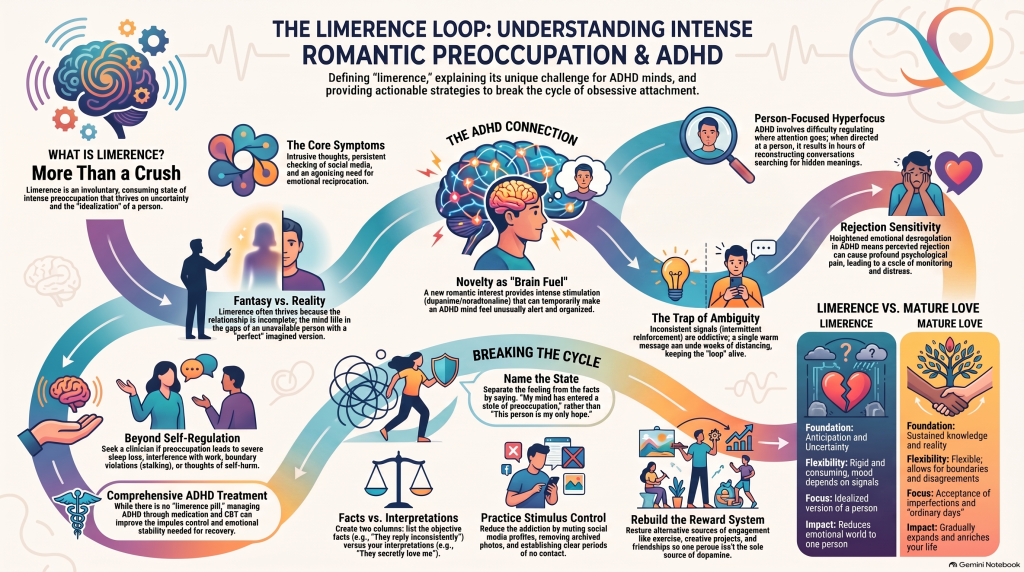 A new romantic interest can bring excitement, hope and renewed energy. You may find yourself thinking about the person frequently, replaying conversations and imagining a possible future together.
This is often a normal part of attraction.
But sometimes the experience becomes far more intense. Thoughts about the person begin to intrude into work, sleep and ordinary life. A delayed reply produces panic. A warm message creates euphoria. The person becomes the centre of one’s emotional world—even when there is little actual relationship.
This state is often described as limerence.
For some people with ADHD, the combination of novelty-seeking, hyperfocus, impulsivity and emotional dysregulation may make this pattern particularly difficult to regulate. However, an important scientific qualification is necessary: limerence remains an under-researched concept, and we do not yet have strong studies proving that it is more prevalent in ADHD. The connection is clinically plausible, but it should not be presented as an established biological fact.
What exactly is limerence?
The term limerence was introduced by psychologist Dorothy Tennov to describe an involuntary state of intense romantic preoccupation.
It is more than simply liking someone or having a crush. Its characteristic features include:
- Persistent and intrusive thoughts about one particular person
- Idealisation and minimisation of obvious incompatibilities
- An intense need to know whether the feelings are reciprocated
- Repeated analysis of messages, expressions and conversations
- Emotional highs after signs of interest
- Severe anxiety or despair after perceived rejection
- Difficulty concentrating on work, studies or existing relationships
- Repeated checking of messages, social media or online status
- A tendency to construct an elaborate imagined relationship
Clinical literature describes limerence as an obsessive attachment capable of producing significant distress and loss of productivity, but it is not currently recognised as a separate psychiatric disorder with established diagnostic criteria.
A crush, limerence and love are not the same
A crush may be exciting, but usually remains flexible. You can continue with your work, tolerate uncertainty and eventually redirect your attention.
Limerence is more consuming. Your mood becomes dependent on small signals from the other person. You may know very little about them, yet experience an extraordinary sense of emotional importance.
Mature love develops through sustained knowledge of another human being. It can tolerate imperfections, boundaries, disagreements and ordinary days. It is not based solely on anticipation or uncertainty.
Limerence often thrives precisely because the relationship is incomplete.
The best imaginable relationship may be the one that has never been tested by reality. In the absence of everyday contact, the mind is free to create a nearly perfect person. An actual relationship introduces fatigue, conflicting priorities, irritating habits and genuine differences. Fantasy does not have to deal with any of these.
Why might ADHD make limerence harder to regulate?
1. Novelty can temporarily organise the ADHD mind
ADHD is sometimes described online as a simple “dopamine deficiency.” That explanation is too crude.
Research instead points towards differences in dopamine and noradrenaline signalling, reward processing and the regulation of frontostriatal brain networks. These systems influence motivation, anticipation, sustained effort, inhibition and the ability to direct attention.
A new romantic interest provides several powerful forms of stimulation at once:
- Novelty
- Anticipation
- Emotional intensity
- Uncertainty
- Social reward
- Immediate feedback
For a person who often struggles to feel engaged by routine tasks, this can produce an unusual sense of alertness and psychological organisation.
They may think:
“I finally feel alive.”
“I can suddenly focus.”
“This person understands me in a way nobody else does.”
The person may then be credited with producing an emotional state that actually arises from a much larger interaction between novelty, reward, imagination and the individual’s nervous system.
The mind begins to pursue not only the person, but also the internal state associated with thinking about them.
2. Hyperfocus can become person-focused
ADHD does not always mean an inability to pay attention. It often involves difficulty regulating where attention goes and when it disengages.
Studies show that adults with higher ADHD symptoms frequently report episodes of prolonged, intense focus, particularly when an activity is interesting or rewarding. This is commonly called hyperfocus.
Hyperfocus may be useful when directed towards art, research, business or problem-solving. But when directed towards another person, it can become exhausting.
The mind may repeatedly:
- Reconstruct conversations
- Search for hidden meanings
- Imagine future encounters
- Draft and redraft messages
- Check whether the person is online
- Review photographs and social-media activity
- Seek reassurance from friends
Importantly, research has not yet established “romantic hyperfocus” as a distinct ADHD symptom. It is better understood as a possible application of broader attentional dysregulation.
3. Uncertainty can intensify the attachment
Clear reciprocation may eventually allow a relationship to become ordinary and reality-based. Clear rejection, though painful, can eventually permit grieving.
Ambiguity is often more difficult.
Statements such as these can keep the loop alive:
“I like you, but I am not ready.”
“Maybe sometime in the future.”
“I miss you, but we should not be together.”
“Let us just see where this goes.”
Occasional affection mixed with distance creates repeated cycles of anticipation, reward and disappointment. The person begins searching for the next reassuring signal.
A single affectionate message may undo several weeks of emotional distancing.
This is why inconsistent relationships can sometimes feel more addictive than stable ones. The unpredictability keeps attention engaged.
4. Rejection can feel emotionally overwhelming
Many people with ADHD experience significant emotional dysregulation, including rapid emotional escalation, difficulty recovering from distress and heightened negative emotional responses. Meta-analytic evidence indicates that emotional lability and negative reactivity are substantially elevated in many adults with ADHD.
The popular term rejection-sensitive dysphoria, or RSD, is widely used to describe intense pain following perceived criticism or rejection. It is not, however, an official psychiatric diagnosis.
It is more accurate to assess the person for:
- Rejection sensitivity
- Emotional dysregulation
- Social anxiety
- Low self-esteem
- Attachment insecurity
- Previous bullying or relational trauma
- Depression or anxiety
- Borderline personality traits, when clinically relevant
Social rejection can produce genuine psychological pain. Neuroimaging research has demonstrated that exclusion activates brain systems involved in the distress associated with social pain.
During limerence, however, the mind may interpret every ambiguous event as rejection:
- A reply arriving after three hours
- A shorter message than usual
- A change in punctuation
- A cancelled meeting
- The person appearing happy with somebody else
- A neutral facial expression
This creates a repeated sequence:
Hope → monitoring → uncertainty → perceived rejection → distress → reassurance-seeking → temporary relief → renewed hope
What feels like evidence of a profound relationship may partly be evidence of a powerful reinforcement loop.
5. Fantasy fills the gaps left by limited information
Limerence frequently develops around someone who is unavailable, inconsistently available or not fully known.
The person may be:
- A colleague
- A therapist, teacher or authority figure
- A former partner
- Someone already in another relationship
- A long-distance online contact
- A person who provides occasional emotional intimacy but avoids commitment
The fewer the ordinary realities available, the more space the mind has to construct an idealised version.
The limerent individual may become attached not only to who the person is, but to what the person represents:
- Rescue from loneliness
- Proof of being desirable
- A more exciting life
- A chance to correct an earlier rejection
- Emotional safety
- Social status
- The hope of becoming a different person
Therefore, losing the imagined relationship may feel like losing an entire possible future.
Why willpower alone often fails
People experiencing limerence commonly tell themselves:
“I should just stop thinking about them.”
But direct thought suppression often increases mental monitoring. To check whether you have stopped thinking about someone, the brain must first search for thoughts of that person.
The person may then feel ashamed:
“Why am I behaving like this?”
“I am a successful adult. Why can I not control myself?”
“There must be something uniquely special about this connection.”
The inability to disengage is then interpreted as proof of destiny.
But intensity is not the same as compatibility.
A feeling can be powerful without being a reliable guide to the quality of a relationship.
The digital environment makes limerence stronger
Earlier generations had natural periods of separation. Today, social media allows almost continuous access to fragments of another person’s life.
Someone experiencing limerence may repeatedly check:
- Last-seen status
- Story views
- Likes and reactions
- New followers
- Profile photographs
- Online activity
- Whether a message has been read
- Who the person is spending time with
Each check promises certainty but usually produces more questions.
The behaviour briefly reduces anxiety, which teaches the brain to check again. Over time, checking itself becomes compulsive.
How to begin breaking the limerence cycle
Name the state without humiliating yourself
Instead of saying, “This person is my only chance at happiness,” try:
“My mind has entered a state of intense romantic preoccupation.”
This does not invalidate your emotions. It separates the experience from the conclusions being drawn from it.
You can feel longing without automatically accepting every story produced by longing.
Separate facts from interpretations
Create two columns.
Facts
- We have met three times.
- They reply inconsistently.
- They have said they are not ready for a relationship.
- They cancel plans frequently.
Interpretations
- They are afraid because the connection is too intense.
- They secretly love me.
- If I remain patient, they will eventually choose me.
- Nobody else could understand me like this.
Limerence grows when interpretations are repeatedly treated as facts.
Reduce intermittent reinforcement
Continued occasional contact can keep the attachment activated.
Depending on the circumstances, recovery may require:
- Muting or unfollowing the person
- Stopping repeated profile checking
- Avoiding unnecessary “just checking on you” messages
- Limiting contact to practical matters
- Removing photographs and archived conversations from immediate access
- Establishing a clearly defined period of no contact
This is not punishment. It is stimulus control.
Delay impulsive communication
When emotionally activated, write the message without immediately sending it.
Introduce a delay—perhaps several hours or until the following day. Then ask:
- What outcome am I seeking?
- Has this message been invited?
- Am I trying to communicate or to regulate my anxiety?
- Will sending it preserve my dignity and the other person’s boundaries?
The aim is not emotional suppression. It is creating enough time for reflective decision-making.
Rebuild a broader reward system
A life with very few rewarding experiences gives the limerent attachment too much psychological power.
Recovery requires deliberately restoring alternative sources of engagement:
- Exercise
- Structured work goals
- Friendships
- Creative projects
- Learning
- Travel and novelty
- Sleep regularity
- Community involvement
- Purposeful routines
The goal is not merely to distract yourself. It is to build a life in which one person is no longer the sole source of stimulation, hope and emotional meaning.
Treat ADHD comprehensively
Adequate ADHD treatment may improve attention regulation, impulse control, planning and emotional stability. Treatment may include medication, cognitive behavioural strategies, sleep correction, exercise, environmental modification and work on emotional regulation.
However, there is no established medication specifically for limerence. ADHD medication should not be presented as a direct “cure” for romantic obsession.
A clinician should also assess whether the apparent limerence is being intensified by:
- Major depression
- Anxiety disorders
- Obsessive-compulsive symptoms
- Trauma-related attachment patterns
- Borderline personality organisation
- Substance use
- Autism-related social interpretation difficulties
- Bipolar hypomania or mania
- Delusional beliefs about reciprocation
The correct formulation matters because similar outward behaviour can arise from very different psychological processes.
When does professional help become important?
Consider seeking assessment when the preoccupation:
- Interferes with work or studies
- Causes severe sleep disturbance
- Leads to repeated unwanted contact
- Damages an existing relationship or marriage
- Produces self-harm thoughts or profound hopelessness
- Causes dangerous driving, substance use or impulsive sexual behaviour
- Persists despite clear rejection
- Leads to monitoring, following or boundary violations
- Is accompanied by reduced need for sleep, unusually high energy or grandiose beliefs
- Includes certainty that the other person secretly communicates or reciprocates despite evidence to the contrary
Treatment may involve cognitive behavioural therapy, work on attachment and relational patterns, emotion-regulation training, response prevention, management of ADHD and treatment of associated depression, anxiety, OCD-spectrum symptoms or mood instability.
A published clinical case has described improvement using a cognitive-behavioural approach incorporating exposure and response-prevention principles, but the evidence base remains preliminary.
The purpose of naming limerence
Learning the word limerence will not immediately stop the longing.
But naming the pattern can create a crucial separation:
“This feeling is real, but the story my mind is constructing may not be entirely reliable.”
That small distinction is where regulation begins.
The goal is not to become emotionally cold or incapable of falling in love. People with ADHD may bring spontaneity, emotional depth, creativity and extraordinary enthusiasm into relationships.
The goal is to prevent intensity from replacing reality.
Healthy love becomes clearer as two people know each other better. Limerence often becomes stronger in the spaces where knowledge, certainty and reciprocity are missing.
A relationship should gradually expand your life—not reduce your entire emotional world to whether one person has replied.
About the Author
Dr. Srinivas Rajkumar T
MD Psychiatry, AIIMS New Delhi
Senior Consultant Psychiatrist
Mind & Memory Clinic, Apollo Clinic Velachery, Chennai
Opposite Phoenix Marketcity
The clinic provides comprehensive assessment and personalised treatment planning for adult ADHD, emotional dysregulation, relationship difficulties, anxiety, obsessive thinking and associated functional problems.