What Does Your Calendar Say You Value? The Hidden Cost of a Successful Career
 There is a question every ambitious person should probably ask at least once a year:
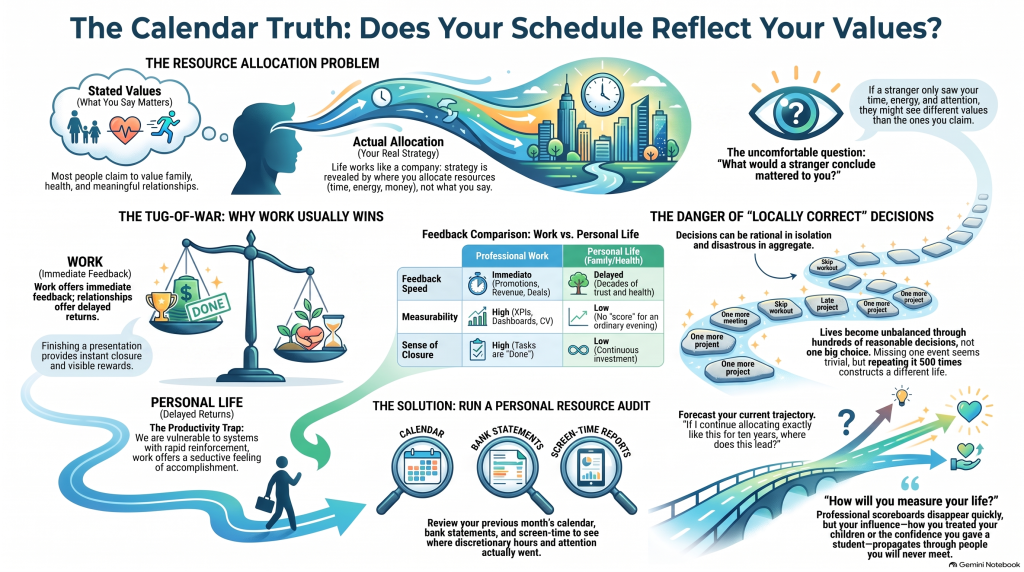
If someone could see only where I spent my time, energy and attention—not what I said was important—what would they conclude actually mattered to me?
It is an uncomfortable question.
And that is precisely why it is useful.
The Clayton Christensen Problem
Clayton Christensen was one of the world’s most influential thinkers on business strategy. He spent much of his academic career studying why successful companies eventually fail.
But toward the end of his Harvard Business School course, he turned the same strategic thinking toward something more personal:
How do successful people end up building lives they never intended to build?
Christensen had watched the trajectories of people around him. Many were extraordinarily talented and professionally successful. Yet over the years, some experienced unhappy marriages, divorce, distant relationships with their children or lives that seemed surprisingly empty despite impressive careers.
These were not people who had planned badly.
Most had probably started adulthood wanting roughly the same things many of us want:
A meaningful career.
Financial security.
A good marriage.
Children who remain close to us.
Friends.
Health.
A sense that our life mattered.
So how does someone who values all these things gradually construct a life dominated almost entirely by work?
Christensen’s answer came from an idea he already understood extremely well from business:
resource allocation.
Your Real Priorities Are Revealed by Your Resources
Companies publish strategies.
But Christensen argued that the strategy that actually gets implemented is revealed by where the company allocates its resources.
Life works remarkably similarly.
We can say:
Family comes first.
Health is important.
I value my friendships.
I want to be present for my children.
I don’t live merely to work.
But look at the allocation.
Where did your last 1,000 waking hours go?
Where did your best mental energy go?
What receives immediate attention when two things compete?
What gets postponed?
Your calendar may provide a more accurate description of your priorities than your beliefs do.
Why Work Usually Wins
There is a structural advantage that work has over almost everything else in life:
work gives immediate feedback.
Finish a presentation and it is done.
Close a deal and revenue appears.
Publish a paper and your CV changes.
See another patient and you earn another consultation fee.
Get promoted and your designation changes.
Build a company and you can watch its numbers grow.
The relationship between effort and reward is visible.
Human relationships operate on a completely different timescale.
You spend an evening talking to your spouse.
Nothing measurable happens.
You play with your child for an hour.
There is no performance indicator.
You visit your parents.
No number increases.
You have dinner with an old friend.
Nothing appears on your résumé.
The return may emerge 10, 20 or 30 years later.
That hour with your child may contribute to whether they trust you when they are 25.
Those conversations with your spouse may determine whether you still enjoy sitting together when you are 65.
Those ordinary evenings with friends may eventually constitute some of the most meaningful memories of your life.
But today?
There is no score.
And human beings are extremely vulnerable to systems that provide rapid reinforcement.
The Productivity Trap
Imagine that you unexpectedly receive two free hours.
You could spend them with someone you love.
Or you could finish some pending work.
The work option is seductive because it offers closure.
Two hours later:
Done.
The alternative may provide no comparable feeling of accomplishment.
So you work.
Nothing terrible happens.
Tomorrow another opportunity appears.
You work again.
Still nothing terrible happens.
This is important.
Lives rarely become unbalanced because someone consciously decides:
“My career matters more than everyone I love.”
They become unbalanced through hundreds of individually reasonable decisions.
One more meeting.
One more patient.
One more project.
One more promotion.
One more year of working extremely hard because after this year things will settle down.
Each decision makes sense.
The cumulative outcome may not.
The Danger of Decisions That Are Locally Correct
This is perhaps the deepest lesson.
A decision can be rational in isolation and disastrous in aggregate.
Working late tonight may be sensible.
Missing one family dinner is trivial.
Skipping exercise today doesn’t matter.
Cancelling one meeting with a friend is understandable.
Answering emails during one holiday seems harmless.
But repeat any of these decisions 500 times and you have constructed something entirely different.
This principle extends far beyond careers.
One unhealthy meal rarely matters.
One unnecessary purchase rarely destroys finances.
One evening spent scrolling through a phone rarely damages a relationship.
One night of inadequate sleep rarely damages health.
But lives are built through repetition.
We experience life as individual decisions, while their consequences accumulate as systems.
The Things That Matter Most Often Have the Worst Metrics
Modern professional life has become extraordinarily measurable.
Income.
Net worth.
Promotions.
Degrees.
Publications.
Followers.
Revenue.
Appointments.
Awards.
Business growth.
These numbers are useful.
The problem begins when what is measurable quietly becomes what is valuable.
Consider some of life’s most important questions:
How much does your child trust you?
How comfortable is your spouse telling you something difficult?
How many people would call you when their life falls apart?
How curious are you about the world?
How physically capable will you be at 70?
How many people became more confident because you encouraged them?
How often were you genuinely present when someone needed you?
There are no dashboards for these things.
Yet they may ultimately matter far more than many of the numbers we spend decades optimizing.
Achievement Is Not the Enemy
The lesson should not be reduced to career bad, family good.
Ambition can be deeply meaningful.
Building something valuable matters.
Scientific discovery matters.
Treating patients matters.
Creating companies matters.
Teaching matters.
Financial independence matters.
Mastery matters.
Work itself can be one of the great sources of meaning in human life.
The problem is not ambition.
The problem is unconscious allocation.
A person may consciously choose to devote enormous energy to a mission. That can be an entirely legitimate life.
The danger is waking up decades later and discovering that you made that trade without ever explicitly choosing it.
Some Investments Must Be Made Before You Can See the Return
Financial investors understand compounding intuitively.
Invest early.
Accept that the benefits will initially appear small.
Allow time to do the work.
Relationships operate similarly.
So does health.
So does reputation.
So does knowledge.
So does character.
The difficulty is that these investments compete against activities offering immediate rewards.
The rational response is therefore not merely to remember what matters.
It is to allocate resources to it deliberately.
Put exercise on the calendar.
Protect time with people you care about.
Call your parents.
Maintain friendships before you desperately need them.
Create periods where work cannot expand.
Take holidays before burnout forces them upon you.
Spend time with children while they still want enormous amounts of your time.
The calendar turns abstract values into resource allocation.
Run a Personal Resource Audit
Instead of asking yourself, “What are my priorities?”, try something more objective.
Look at the previous month.
Ignore your intentions.
Look only at the evidence.
Where did your discretionary hours go?
Where did your money go?
Who received your undivided attention?
What repeatedly got postponed?
What occupied your mind when you weren’t working?
Which relationships received investment?
What happened to sleep, exercise and health when work became busy?
Then ask:
If I continue allocating my resources exactly like this for the next ten years, where does this trajectory lead?
That question transforms today’s habits into tomorrow’s life.
Imagine Meeting Yourself Twenty Years From Now
There is another useful thought experiment.
Imagine meeting yourself twenty years from today.
Your future self probably won’t ask:
“Why didn’t we answer more emails?”
But they might ask:
Why didn’t we take better care of our body when it was easier?
Why did we keep postponing that trip?
Why did we allow that friendship to disappear?
Why weren’t we around more?
Why did we continue working long after additional money stopped meaningfully changing our life?
Or perhaps they will say something very different:
I’m glad we took that risk.
I’m glad we built something important.
I’m glad we worked incredibly hard during those years.
I’m glad we were there for those people.
There is no universal correct allocation.
The objective is alignment.
How Will You Measure Your Life?
Christensen eventually framed the question beautifully:
How will you measure your life?
Most professional scoreboards disappear remarkably quickly.
Someone eventually takes your position.
Another person occupies your office.
Your organisation continues.
Technology makes some of your expertise obsolete.
Even achievements that once seemed enormous gradually become lines on a biography.
But human influence behaves differently.
Something you taught a student may shape how they treat thousands of people.
Confidence you gave someone may alter their career.
The way you treated your children may influence how they eventually raise theirs.
Kindness can propagate through people you will never meet.
Perhaps this is why Christensen suggested thinking about life not merely through accomplishments, but through the people whose lives became better because we were part of them.
The Question Worth Asking
So once in a while, forget your stated priorities.
Open your calendar.
Look at your bank statement.
Look at your screen-time report.
Look at whom you called.
Look at where your attention went.
These are records of resource allocation.
And resource allocation eventually becomes a life.
Then ask yourself:
If someone knew nothing about what I claimed to value and could see only where my time, energy and attention went this year, what would they conclude mattered most to me?
If you like the answer, keep going.
If you don’t, the solution probably isn’t another productivity system.
It is to start allocating your life differently—one ordinary decision at a time.