Psychiatry Needs a Radical Departure My Vision for the Future of Psychiatry
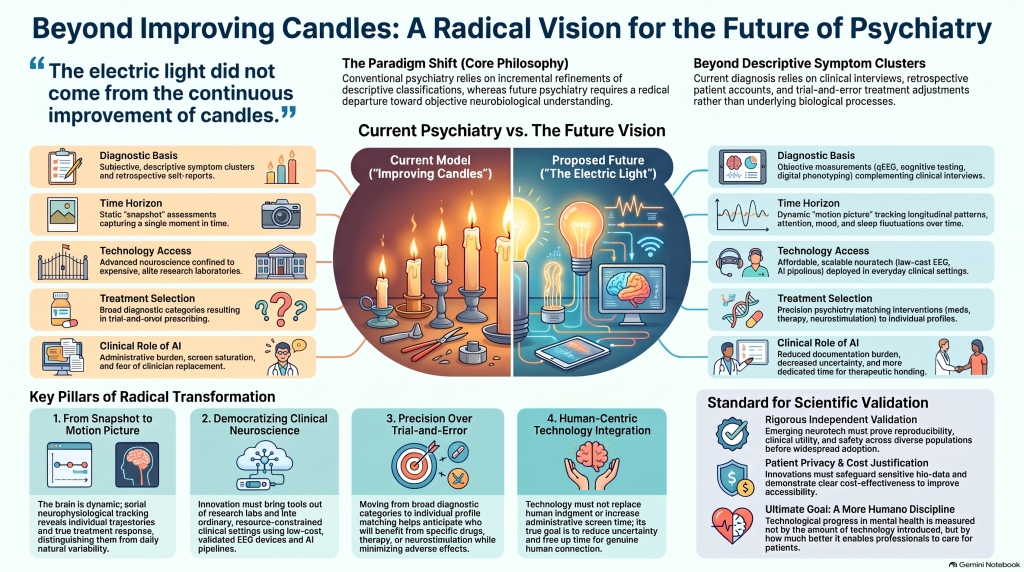
“The electric light did not come from the continuous improvement of candles.”
— Oren Harari
This quote captures something I have increasingly come to believe about the future of psychiatry.
Psychiatry needs a radical departure from conventional approaches—not merely for the advancement of our profession, but for the benefit of the people we serve and the professionals who dedicate their lives to caring for them.
For decades, psychiatry has evolved through refinements in diagnostic classifications, psychopharmacology, psychotherapy, and clinical assessment. These advances have been significant. Millions of people have benefited from them, and I do not wish to diminish their importance.
Yet I often wonder whether we are reaching the limits of what incremental improvements within our existing framework can achieve.
We have become increasingly sophisticated in describing psychiatric symptoms, but our ability to objectively characterise the biological processes underlying many psychiatric disorders remains limited.
We diagnose largely through clinical interviews, symptom clusters, behavioural observations, and retrospective accounts. Treatment frequently involves therapeutic trials, adjustments, and prolonged periods of observation before we can confidently determine what works for an individual.
Can we continue improving this model indefinitely, or should we begin imagining something fundamentally different?
From Descriptive Psychiatry to Measurement-Based Psychiatry
One of the greatest opportunities before us is the possibility of moving beyond predominantly descriptive assessments toward a more comprehensive understanding of brain function, cognition, behaviour, and their changes over time.
I envisage a future where clinical interviews remain central but are complemented by meaningful objective measurements.
Electrophysiology, cognitive performance testing, digital phenotyping, longitudinal behavioural information, and advances in artificial intelligence could collectively provide additional dimensions to psychiatric assessment.
Consider ADHD.
Today, diagnosis rightly depends on developmental history, clinical symptoms, functional impairment, and careful exclusion of alternative explanations.
But imagine a clinical environment where we can supplement this understanding with repeated assessments of attention, executive functioning, electrophysiological patterns, and treatment-related changes.
Not to replace clinical diagnosis with a machine-generated label, but to understand the individual more comprehensively.
This distinction is important. qEEG and other emerging technologies are not currently established as standalone diagnostic tests for ADHD or most other psychiatric conditions. Their true potential must be demonstrated through rigorous research, reproducibility, and evidence of incremental clinical value.
The objective is not to generate more data. It is to generate information that changes clinical decisions and improves outcomes.
From a Snapshot to a Motion Picture
Much of psychiatric assessment captures an individual’s condition at a particular moment.
But the brain is not static.
Attention fluctuates. Mood changes. Cognitive performance varies with sleep, medication, psychological stress, physical activity, and environmental demands.
A single assessment may miss these dynamics.
I am particularly interested in the possibilities offered by affordable, repeated neurophysiological measurements.
Rather than depending exclusively on one elaborate investigation, could we collect smaller amounts of meaningful information repeatedly and examine how these patterns evolve?
Could serial EEG recordings, cognitive assessments, and clinical observations help us identify individual trajectories?
Could artificial intelligence help detect patterns that are difficult to recognise through conventional observation alone?
Most importantly, could such approaches eventually help clinicians distinguish meaningful treatment response from ordinary day-to-day variability?
These remain research questions, but they are questions worth investigating.
I believe the future of psychiatric assessment may lie as much in understanding change over time as in identifying abnormalities at a single point.
Democratising Clinical Neuroscience
Another concern is the distance between sophisticated neuroscience research and everyday psychiatric practice.
We have remarkable advances in computational neuroscience, brain imaging, electrophysiology, and machine learning.
Yet many of these developments remain concentrated in specialised laboratories and academic institutions.
The average clinician may have limited access to these technologies, while patients encounter barriers related to cost, geography, time, and availability.
I would like to see this divide narrow.
My particular interest lies in exploring whether affordable EEG devices, standardised cognitive assessments, and carefully designed AI pipelines can create clinically useful information at a fraction of the cost of conventional research infrastructure.
The goal is not to pretend that low-cost devices are equivalent to high-density research EEG systems.
Rather, it is to identify which measurements can be obtained reliably, which clinically relevant questions they can answer, and where their limitations lie.
If validated, such technologies could make longitudinal measurement more feasible in ordinary clinical settings, including resource-constrained environments.
Innovation should not merely make sophisticated healthcare more sophisticated. It should make meaningful healthcare more accessible.
From Trial-and-Error to More Individualised Treatment
Another area requiring transformation is treatment selection.
Psychiatric disorders are heterogeneous. Two individuals receiving the same diagnosis may differ considerably in underlying mechanisms, cognitive profiles, comorbidities, illness trajectories, and responses to treatment.
Yet our treatments are frequently selected from broad diagnostic categories, with individualisation occurring progressively through clinical experience and therapeutic trials.
I would like to see psychiatry move toward a future in which we can better anticipate who is likely to benefit from a particular intervention, who may experience adverse effects, and who may require a different therapeutic strategy.
This applies not only to medications but also to psychotherapy, neurostimulation, cognitive interventions, and lifestyle-based approaches.
The promise of precision psychiatry is attractive, but it should not remain a slogan.
It must demonstrate measurable improvements in clinical outcomes, safety, accessibility, and cost-effectiveness.
Technology Must Strengthen the Therapeutic Relationship
When I speak about radical transformation, I am not advocating the replacement of psychiatrists with algorithms or the reduction of human suffering to numerical measurements.
Psychiatric practice involves uncertainty, personal narratives, relationships, social circumstances, subjective experiences, and questions of meaning.
No algorithm can be assumed to capture all these dimensions.
The purpose of technology should be to support better-informed clinical judgment, reduce unnecessary uncertainty, and free professionals to spend more meaningful time with patients.
A future psychiatric consultation should not necessarily involve more screens, more forms, and more administrative work.
Ideally, it should involve better information, less repetitive documentation, clearer communication, and more time for genuine human interaction.
The measure of technological progress in psychiatry should not be how much technology we introduce, but how much better we enable people to care for one another.
Innovation Must Benefit Professionals Too
I also believe that any meaningful transformation of psychiatry must improve the professional experience of delivering care.
Mental healthcare professionals work within systems characterised by increasing demands, administrative burdens, emotional labour, workforce shortages, and limited consultation time.
New technologies should not simply create additional responsibilities.
They should help us make better decisions, minimise repetitive work, improve interdisciplinary collaboration, and use our expertise more effectively.
A psychiatrist should be able to devote more attention to complex clinical reasoning and therapeutic engagement rather than spending disproportionate time on tasks that technology could responsibly simplify.
Psychologists, psychiatric nurses, occupational therapists, social workers, and other mental health professionals must also be included in this transformation.
A truly innovative mental healthcare system should benefit everyone involved in delivering and receiving care.
From Vision to Evidence
I recognise that psychiatry has witnessed many promising technologies and biological theories that have not translated into meaningful clinical improvements.
We must be careful not to replace old assumptions with new technological enthusiasm.
For me, a radical departure does not mean abandoning scientific discipline. It means strengthening it.
Any emerging approach must withstand independent validation, demonstrate reliability across populations, establish clinical utility, protect patient privacy, and justify its cost.
I am particularly interested in developing practical research models integrating clinical phenotyping, continuous performance testing, affordable serial EEG, and AI-assisted analysis.
The questions I want to pursue are straightforward:
- Can we improve the reliability and depth of psychiatric assessment?
- Can we identify patterns that add meaningful information beyond conventional clinical evaluation?
- Can we measure treatment response more objectively and longitudinally?
- Can we develop affordable, scalable models that are useful in everyday clinical practice?
- Can we make these advances improve outcomes for patients while supporting the professionals treating them?
These questions represent the direction in which I would like to contribute through clinical practice, research, technological collaboration, and academic work.
Beyond Better Candles
I do not believe that the future of psychiatry should be defined by technology alone.
It must integrate neuroscience, psychology, medicine, social understanding, and the lived experiences of patients.
We need greater scientific precision without losing empathy.
More objective information without ignoring subjective experience.
More efficient systems without compromising professional autonomy.
More innovation without sacrificing accessibility.
And more ambitious research without abandoning the humility that psychiatric science demands.
My vision is of a psychiatry that is more measurable, more predictive, more personalised, more accessible, and ultimately more humane.
One in which clinicians are empowered rather than overwhelmed, and patients receive care that is not only compassionate but increasingly informed by meaningful, individualised evidence.
We should certainly continue improving our existing tools.
But we must also have the courage to question whether those tools, however refined, are sufficient for the future we wish to create.
Perhaps the next great advancement in psychiatry will not come from continuously improving the candles we already have.
Perhaps it will come from having the courage, curiosity, and scientific discipline to discover an entirely new source of light.
Dr. Srinivas Rajkumar T
MD Psychiatry (AIIMS, New Delhi) | DNB Psychiatry
Consultant Psychiatrist | Chennai
#FutureOfPsychiatry #PrecisionPsychiatry #Neuroscience #MentalHealthInnovation #DigitalPsychiatry #AIinHealthcare