ADHD and Smartphone Overuse: An Evidence-Based Strategy to Reclaim Attention
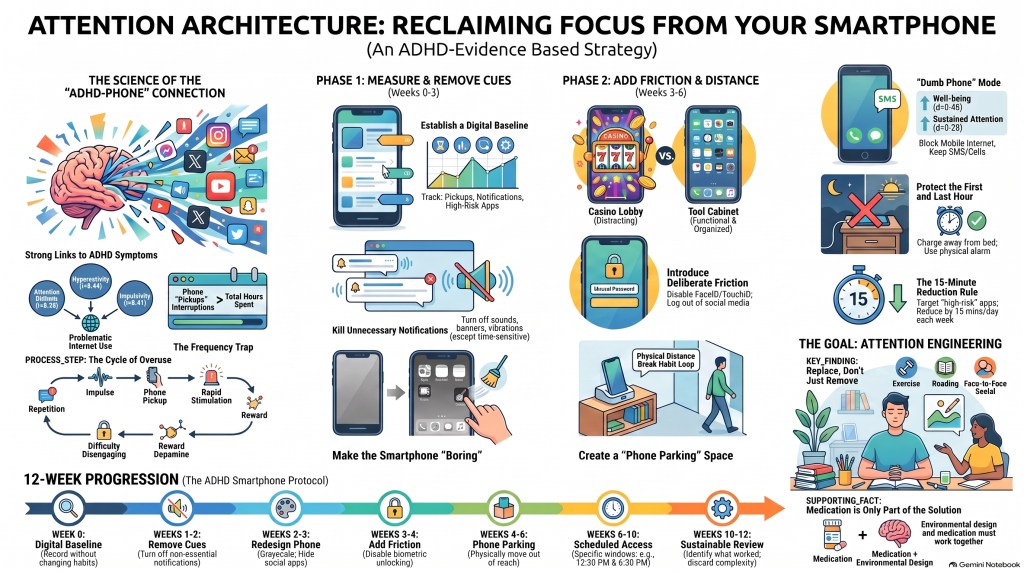 Smartphones are extraordinarily useful. For people with ADHD, however, they can also create an unusually difficult attentional environment.
A modern smartphone combines almost every feature capable of competing for attention: novelty, instant reward, social feedback, short videos, games, messaging, news, shopping and an essentially unlimited stream of new information. More importantly, all of this is available within seconds, throughout the day.
For someone with ADHD, the problem is therefore often not simply “too much screen time.”
It is a repeated cycle:
Cue → impulse → phone pickup → rapid stimulation → reward → difficulty disengaging → repetition.
The most useful treatment strategy may therefore not be asking someone with ADHD to develop more willpower.
It may be to redesign the environment so that less willpower is required.
ADHD and Smartphones Are an Especially Powerful Combination
Research increasingly shows that ADHD is associated with problematic forms of digital-media use.
A 2025 meta-analysis involving 35,223 participants found a moderate association between ADHD symptoms and problematic social-media use, with an overall correlation of r = 0.361.
Another meta-analysis examining problematic internet use found associations with:
- attention deficit: r = 0.36
- hyperactivity: r = 0.44
- impulsivity: r = 0.41.
And a 2026 systematic review and meta-analysis involving 235,283 children and adolescents found that those with ADHD were more likely to spend two or more hours per day using screens and generally accumulated greater screen exposure than typically developing peers. The certainty of some of this evidence was low, so these findings should not be interpreted as proof that screens cause ADHD.
The relationship is likely complex and bidirectional.
People with ADHD may be more attracted to highly stimulating digital environments because of impulsivity, boredom intolerance, reward sensitivity and difficulty delaying gratification. At the same time, constantly fragmented digital attention may make sustained concentration even harder.
Recent longitudinal and systematic evidence supports an association between problematic digital media use and ADHD-related symptoms, particularly inattention and impulsivity, although causation remains incompletely established.
The important clinical message is therefore:
ADHD does not make smartphones inherently harmful. It can make certain smartphone designs unusually difficult to regulate.
The Goal Is Not to Eliminate Smartphones
A useful ADHD intervention should not begin with:
“Stop using your phone.”
Smartphones are needed for navigation, banking, work, communication, education, authentication, appointments and countless everyday tasks.
The more realistic goal is:
Keep the useful smartphone. Remove as much of the attention-capturing smartphone as possible.
This is also the philosophy behind an important ADHD-specific trial currently underway.
A 2025 BMC Psychiatry study protocol describes a randomized controlled trial involving 120 adolescents with clinically diagnosed ADHD and smartphone overuse. Participants in the intervention arm receive a 12-week individualized behavioural intervention rather than simply being told to reduce screen time.
The researchers explicitly state that the objective is not to eliminate smartphone use, but to increase control over smartphone behaviour using device settings, behavioural strategies and self-awareness.
Importantly, this is currently a study protocol rather than a completed efficacy trial, so its intervention should be viewed as scientifically informed and under evaluation—not yet proven specifically for ADHD.
Nevertheless, when combined with completed randomized trials of smartphone interventions in the general population, it provides an excellent framework.
A Better Model: Build an “Attention Architecture”
The central principle is simple:
Do not repeatedly place an ADHD brain in front of hundreds of tempting cues and then demand perfect inhibition.
Instead, change the cues.
This can be approached systematically.
Step 1: Measure Before You Restrict
Most people substantially underestimate how frequently they interact with their phone.
Instead of asking:
“How many hours do you use your phone?”
look at the objective data.
Apple Screen Time and Android Digital Wellbeing already provide much of what is required.
The ADHD trial proposes monitoring:
- total smartphone minutes
- time spent in different categories
- social-media use
- gaming and entertainment
- number of phone pickups/unlocks
- number of notifications received.
This is an excellent starting point.
For clinical use, I would additionally examine:
1. First phone use after waking
Is the phone picked up within two minutes of waking?
2. Last use before sleep
Is the patient scrolling in bed?
3. High-risk applications
Instagram, YouTube Shorts, X, Reddit, games or another individual’s specific digital weakness.
4. Number of pickups
A person may accumulate only three hours of smartphone use but interrupt themselves 150 times.
That may be more relevant to attention than total duration alone.
Screen time is therefore only one biomarker of digital behaviour.
For ADHD, frequency of attentional interruption may be equally important.
Step 2: Kill Unnecessary Notifications
One of the easiest interventions is also one of the most rational.
Turn off almost everything.
The ADHD trial specifically recommends reducing:
- sounds
- banners
- vibrations
- low-priority messages
and using Do Not Disturb while studying or working. Participants are also asked to keep smartphones out of sight and out of reach.
This makes sense neurologically.
A notification does not merely consume the few seconds required to read it. It creates an attentional shift:
task → notification → application → another piece of content → return to task.
For someone whose difficulty already involves sustaining attention and resisting competing stimuli, deliberately generating dozens or hundreds of these cues every day is counterproductive.
Keep notifications for genuinely time-sensitive functions.
Everything else can wait.
Step 3: Make the Smartphone Boring
The smartphone industry spends enormous resources making screens attractive.
Treatment can deliberately move in the opposite direction.
A randomized nudge-based intervention tested strategies including:
- greyscale displays
- disabling unnecessary notifications
- keeping the phone away
- reducing accessibility of distracting applications.
Participants showed reductions in problematic smartphone use and screen time, while sleep quality also improved compared with screen-time monitoring alone.
A practical ADHD-friendly home screen might contain only:
- Phone
- Messages
- Maps
- Calendar
- Camera
- Notes
- Banking
- authenticator
- essential work applications.
Move entertainment applications off the first page.
Better still, remove highly problematic applications and access them from a computer.
The home screen should function like a tool cabinet, not a casino lobby.
Step 4: Introduce Friction
This may be one of the most important principles for ADHD.
Many problematic behaviours become automatic because they require almost no effort.
Consider the sequence:
pick up phone → Face ID → Instagram → Reels
It can occur before a conscious decision has really been made.
The ADHD smartphone trial proposes an interesting intervention: disabling Touch ID or Face ID and requiring a password instead, deliberately making phone access slightly less convenient.
This idea deserves attention.
For useful behaviours, convenience is valuable.
For compulsive behaviours, a little inconvenience can be therapeutic.
A five- or ten-second delay before opening a problematic application gives the prefrontal system another opportunity to ask:
“Why am I opening this?”
Other friction strategies include:
- logging out after use
- removing apps from the home screen
- disabling automatic login
- using application limits
- requiring a password for selected apps
- blocking specific sites during work
- accessing social media only through a computer.
The aim is not punishment.
It is to transform an automatic response into a conscious decision.
Step 5: Put the Phone Physically Away
A common compromise is:
“I’ll keep it face-down beside me.”
For serious focused work, that may not be enough.
Instead, create a phone parking place.
During a 30- or 60-minute work block:
- smartphone goes into a drawer,
- onto a shelf,
- into another room,
- or somewhere requiring the person to physically stand up to retrieve it.
That distance introduces another useful response cost.
Checking the phone is no longer:
hand → phone.
It becomes:
stop working → stand up → walk → retrieve phone → unlock it.
That tiny behavioural barrier is important.
The ADHD trial similarly recommends placing the phone out of sight and out of reach during periods requiring concentration.
Step 6: Separate “Communication” From “Infinite Internet”
One of the most interesting smartphone experiments published recently did something radical.
Researchers recruited 467 participants and blocked mobile internet access on their smartphones for two weeks while still allowing:
- telephone calls
- SMS
- internet access through computers and other devices.
In effect, participants temporarily converted their smartphones into sophisticated “dumb phones.”
The results were striking.
After blocking mobile internet, participants demonstrated improvement in:
- subjective well-being: d ≈ 0.45
- mental health: d ≈ 0.56
- objectively measured sustained attention: d ≈ 0.23.
About 91% improved on at least one of the three outcomes.
The sustained-attention outcome is particularly interesting because it was measured using a continuous performance task rather than simply asking participants whether they felt more focused.
Participants also spent more time:
- socialising face-to-face
- exercising
- outdoors
- sleeping
and less time consuming media.
The intervention was not specifically an ADHD treatment, so its results should not be extrapolated directly to clinically diagnosed ADHD.
But the principle is highly relevant.
Perhaps the problem is not simply “the internet.”
It is the internet being available in your pocket every second of the day.
Step 7: Create Deliberate Periods of “Dumb Phone Mode”
An ADHD patient may therefore not need to abandon a smartphone permanently.
Instead, create strategic periods during which the smartphone stops behaving like a smartphone.
For example:
9 AM–12 PM
Calls, messages and music allowed.
No social media, news, browsing, shopping or short-form video.
2 PM–5 PM
Second protected work block.
After 10 PM
No internet-based entertainment.
This preserves functionality while eliminating unlimited digital stimulation during periods when sustained attention matters.
For some individuals, a two-week experiment with much more aggressive restriction may be worthwhile.
The question becomes:
What happens to my concentration when constant mobile internet disappears?
That is a far more informative experiment than simply looking at an arbitrary screen-time number.
Step 8: Protect the First and Last Hour of the Day
Two periods deserve special protection:
The first hour after waking
Opening social media immediately exposes the brain to novelty, emotionally salient information and competing priorities before the day’s own goals have been established.
A better sequence is:
wake → hygiene → breakfast → exercise/planning/work → phone.
Not:
wake → notifications → WhatsApp → Instagram → YouTube → news → 45 minutes disappear.
The final hour before sleep
The ADHD study proposes scheduled smartphone downtime beginning 30 minutes before habitual sleep, together with replacement activities such as:
- reading
- journaling
- stretching
- talking with family.
For many patients, I would go further.
Charge the phone away from the bed.
The bedside phone combines several problematic behaviours:
- bedtime procrastination
- short-video consumption
- repeated messaging
- late-night novelty seeking
- immediately checking the device after waking.
A cheap alarm clock can sometimes be a surprisingly effective psychiatric intervention.
Step 9: Reduce High-Risk Content Gradually
Not every smartphone activity carries equal risk.
Reading a PDF for 40 minutes and watching short-form video for 40 minutes are both recorded as “40 minutes of screen time.”
Behaviourally they are very different.
The ADHD protocol specifically proposes targeting high-use but non-essential applications, hiding them away from the main screen and gradually reducing exposure.
Its suggested reduction is 15 minutes per day each week for selected content.
This gradual strategy may work particularly well for patients who repeatedly fail at complete abstinence.
Week 1:
90 minutes.
Week 2:
75 minutes.
Week 3:
60 minutes.
Week 4:
45 minutes.
The target can then be individualized.
The objective is not a universally “correct” number.
It is regaining control.
Step 10: Replace Stimulation—Do Not Simply Remove It
This may be the difference between a sustainable intervention and a failed digital detox.
If someone with ADHD uses the phone whenever they are:
- bored
- lonely
- restless
- anxious
- waiting
- mentally fatigued,
removing the phone leaves a behavioural vacuum.
Something must replace it.
Useful alternatives include:
- exercise
- swimming
- walking
- sport
- music
- reading
- drawing
- conversation
- gardening
- cooking
- physical hobbies
- brief social interaction.
The mobile-internet RCT is particularly informative here.
When constant smartphone internet access disappeared, people did not simply sit doing nothing.
They redistributed their time toward offline activities, including social interaction, physical activity and being outdoors. These behavioural changes partly mediated improvements in well-being.
This gives us an important therapeutic principle:
Do not merely subtract dopamine-rich digital behaviour. Build competing sources of reward.
Step 11: Do Not Rely on Screen-Time Monitoring Alone
Simply showing someone their Screen Time statistics often produces an initial reaction:
“Five hours? That’s terrible.”
For several days they improve.
Then behaviour returns.
The nudge-based randomized trial is useful because its control participants also monitored screen time. The behavioural intervention nevertheless produced better outcomes than monitoring alone.
So measurement is necessary.
But measurement is not treatment.
The environment must change.
Step 12: Avoid the “Two-Hour Rule” Trap
A 2025 randomized controlled trial asked healthy university students to reduce smartphone use to two hours or less per day for three weeks.
Participants started at approximately 276 minutes per day.
The intervention produced improvements in:
- depressive symptoms
- stress
- sleep
- well-being.
But there is another important lesson.
After restrictions ended, smartphone use increased again.
That is why digital detoxes often fail.
An intervention should not merely prove that somebody can survive three weeks with less smartphone use.
It should identify changes that can still exist three years later.
For many people that may mean permanently retaining:
- almost no non-essential notifications
- phone-free work periods
- phone outside the bedroom
- blocked short-video applications
- intentional social-media windows
- additional friction before distracting apps.
A Practical 12-Week ADHD Smartphone Protocol
Combining the emerging ADHD-specific intervention model with broader randomized-trial evidence produces a practical framework.
Week 0 — Digital Baseline
Do not change anything yet.
Record for seven days:
- screen time
- pickups
- notifications
- top five applications
- social-media minutes
- short-video minutes
- first morning use
- bedtime use.
Weeks 1–2 — Remove Cues
Turn off:
- promotional notifications
- news notifications
- social-media notifications
- shopping notifications
- gaming notifications
- unnecessary vibration
- badges.
Activate Focus/Do Not Disturb during concentration periods.
Weeks 2–3 — Redesign the Phone
- switch to greyscale if acceptable
- simplify the home screen
- remove social applications from page one
- delete unnecessary apps
- remove widgets that continuously update
- use a plain wallpaper.
Weeks 3–4 — Add Friction
For problematic applications:
- disable instant login
- move them several screens away
- add app limits
- use blocking software
- consider disabling biometric unlocking
- introduce a short delay before access.
Weeks 4–6 — Introduce Phone Parking
During:
- studying
- consultations
- writing
- meetings
- exercise
- meals
place the phone somewhere requiring deliberate retrieval.
Weeks 6–8 — Introduce Scheduled Connectivity
Instead of checking continuously, create specific windows.
For example:
12:30 PM — messages/social media
6:30 PM — messages/social media
Outside these periods, high-risk applications remain unavailable.
Weeks 8–10 — Protect Sleep
- downtime 30–60 minutes before bed
- no short-form video in bed
- phone charges away from the pillow
- ideally outside arm’s reach
- use a separate alarm clock when practical.
Weeks 10–12 — Find the Minimum Sustainable System
Look at the objective data again.
Which interventions actually changed behaviour?
Keep those.
Discard unnecessary complexity.
The goal is not to create a life filled with digital rules.
The goal is to create an environment in which attention is easier to control.
What Should We Measure?
For ADHD, I would not use total screen time as the sole outcome.
A better digital-attention dashboard would include:
Smartphone outcomes
- minutes/day
- pickups/day
- notifications/day
- short-video minutes
- social-media minutes
- nighttime use.
ADHD outcomes
- task completion
- procrastination
- missed deadlines
- work/study interruptions
- subjective distractibility
- functional impairment.
Objective attention
Where clinically appropriate:
- Continuous Performance Testing
- sustained-attention measures
- response variability
- omission errors
- commission errors.
The ongoing ADHD trial is itself moving toward this multidimensional model by combining smartphone behaviour with ADHD symptom ratings and resting-state EEG measures.
That is scientifically far more interesting than simply declaring that somebody spent “four hours on their phone.”
What About ADHD Medication?
Appropriate ADHD treatment remains important.
Medication can improve core symptoms such as:
- attention
- impulse control
- task persistence
- executive functioning.
But medication should not be expected to undo an environment deliberately engineered to interrupt attention hundreds of times per day.
The 2026 screen-time meta-analysis found no convincing indication that ADHD medication alone normalized screen exposure among children and adolescents.
Therefore:
Treat ADHD as ADHD—and treat problematic smartphone behaviour as a behaviour.
These approaches are complementary.
Smartphones Are Not the Enemy
It is easy to turn discussions about digital technology into moral panic.
That is neither scientifically accurate nor clinically useful.
For many people with ADHD, smartphones are enormously helpful.
They provide:
- reminders
- calendars
- alarms
- navigation
- timers
- medication reminders
- note-taking
- task managers
- accessibility tools
- educational material.
The same device can either compensate for ADHD or amplify distraction.
The difference often lies in how the device is configured.
The Core Principle
The traditional advice is:
“Develop better self-control.”
For ADHD, a more sophisticated approach is:
“Build an environment that demands less self-control.”
That means:
Measure → remove cues → add friction → increase physical distance → restrict connectivity during vulnerable periods → schedule intentional access → replace digital stimulation → review objective behaviour → retain sustainable changes.
This is not simply “digital detox.”
It is attention engineering.
And for people with ADHD, attention engineering may eventually become an important part of comprehensive treatment alongside diagnosis, medication, psychological intervention, sleep, exercise and occupational or academic restructuring.
Attention. Understood.
At ATTN Clinic, we approach ADHD as more than a symptom checklist. Attention difficulties may arise from ADHD, but they can also be influenced by sleep, anxiety, depression, excessive digital stimulation, other psychiatric conditions and medical or nutritional factors.
Our approach is therefore to understand why attention is failing, how it affects everyday functioning, and where useful objective measurements can complement clinical assessment.
ATTN Clinic
Attention. Understood.
Currently functioning from:
Apollo Clinic, Opp. Phoenix Market City, Velachery, Chennai
Appointments: +91 85951 55808
Email: srinivasaiims@gmail.com