Frank Autism: When Autism Is Apparent Within Minutes — and Why First Impressions Are Not Enough
 Autism spectrum disorder is extraordinarily heterogeneous. Some autistic people present with social-communication differences that become apparent almost immediately during an interaction. Others may speak fluently, maintain apparently adequate eye contact, have successful careers and relationships, and show relatively subtle differences that become evident only after a detailed developmental history and prolonged clinical assessment.
This distinction has led researchers to examine an interesting clinical concept: “frank autism.”
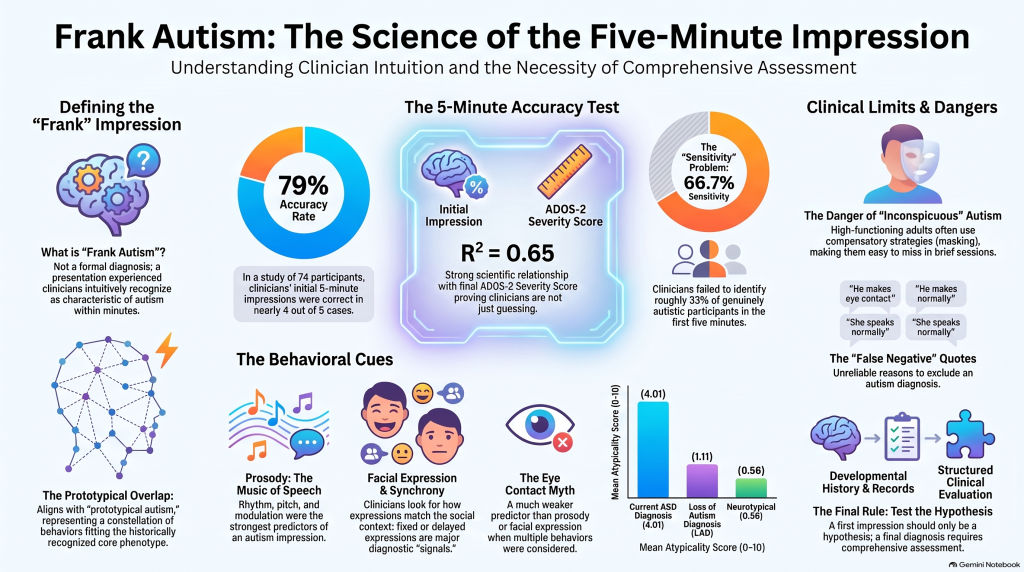
The term does not represent a separate DSM or ICD diagnosis, nor does it imply a different type of autism. Rather, frank autism describes a presentation in which experienced clinicians develop a strong impression of autism within the first few minutes of observing or interacting with a person. The construct appears to overlap with what some researchers have called “prototypical autism”—a constellation of behaviours that experienced clinicians intuitively recognise as characteristic of autism.
A 2024 study published in Molecular Autism by Canale and colleagues provides an intriguing examination of whether such impressions are scientifically meaningful, particularly in adolescents and adults.
Can a clinician really recognise autism in five minutes?
Clinicians frequently report forming an early diagnostic impression long before an autism evaluation has been completed.
Earlier work cited by the authors found that 97% of autism-specialist clinicians believed that something resembling “frank autism” exists, and estimated that they could often recognise this presentation within approximately ten minutes. Those clinicians estimated that perhaps 40% of people with ASD showed such a recognisable phenotype.
But an intuitive impression is not the same thing as a diagnosis.
Canale and colleagues therefore asked a more rigorous question:
How closely does a clinician’s impression during the first five minutes correspond with the eventual diagnosis obtained after a comprehensive autism assessment?
The researchers studied 74 participants between 12 and 39 years of age:
- 24 currently meeting criteria for autism
- 24 who had been diagnosed with autism in early childhood but no longer met current diagnostic criteria—a group termed loss of autism diagnosis (LAD)
- 26 neurotypical participants.
Graduate-level clinicians with specialised autism training and highly experienced PhD-level autism clinicians watched only the first five minutes of the diagnostic session. They did not know the participant’s diagnostic group. They then indicated whether the person appeared autistic or non-autistic and rated specific behaviours contributing to that impression.
Their impressions were subsequently compared with the much more comprehensive diagnostic evaluation.
Five minutes contained a surprising amount of information
Overall, the initial impressions were approximately 79% accurate.
Even more interestingly, the degree of behavioural atypicality noticed during those first minutes correlated strongly with the participant’s later ADOS-2 Calibrated Severity Score. The relationship accounted for a substantial proportion of variation, with an R² of 0.65.
So clinicians were not simply guessing.
There appears to be genuine clinical information contained within very brief social interactions.
But the most important finding may actually be where those impressions failed.
The sensitivity of the five-minute impression was only 66.7%, while specificity was substantially higher at 88%. Positive predictive value was 72.7% and negative predictive value 84.6%.
In practical terms, approximately one-third of genuinely autistic participants did not initially appear autistic to clinicians.
That observation is crucial.
Frank autism is not the same as autism
A person may have autism without having a frankly autistic presentation.
The reverse distinction is clinically important because otherwise we risk converting an experienced clinician’s intuition into an inappropriate diagnostic shortcut:
“He doesn’t look autistic.”
“She makes eye contact.”
“He speaks normally.”
“I spoke with her for ten minutes and didn’t notice anything unusual.”
None of these statements reliably excludes autism.
Indeed, even clinicians specifically trained in autism failed to develop an initial autism impression in roughly one-third of autistic individuals in this study. The authors therefore emphasise that brief observation cannot substitute for a detailed assessment.
What actually creates the impression of “frank autism”?
Perhaps the most fascinating part of the study was the attempt to identify exactly what clinicians were noticing.
The researchers rated eight behavioural domains:
- gestures
- eye contact
- motor mannerisms
- prosody and vocalisations
- facial expressions
- attention and attentional shifting
- social reciprocity
- social initiation.
Several domains differed between autistic and non-autistic groups, including gesture, eye contact, prosody, facial expression, social reciprocity and social initiation.
But two features stood out above the others:
prosody and facial expression.
When all the behavioural variables were considered together, these two were the strongest predictors of whether clinicians formed an initial impression of autism.
1. Prosody
Prosody refers to the music of speech—rhythm, pitch, emphasis, intonation, timing and modulation.
Some autistic individuals may have speech that sounds unusually:
- flat or monotonous
- overly formal
- sing-song
- mechanically rhythmic
- excessively precise
- unusually loud or soft
- poorly synchronised with the emotional content of the conversation.
Interestingly, the actual words being spoken may be perfectly sophisticated. What catches the clinician’s attention is often how the language is delivered rather than its grammatical complexity.
2. Facial expression
The second major contributor was the quality and modulation of facial expression.
This does not simply mean “not smiling.”
The issue can involve the synchronisation between facial expression, language, emotion and the ongoing interpersonal exchange. Expression may appear unusually reduced, exaggerated, fixed, delayed or poorly matched to the social context.
Prosody and facial expression predicted frank-autism impressions across the autistic, LAD and neurotypical groups.
What about eye contact?
Eye contact is frequently treated by the public—and unfortunately sometimes even clinically—as almost synonymous with autism.
The results provide a more nuanced picture.
Eye contact differed between groups and contributed to clinicians’ impressions in some circumstances. But once multiple behaviours were considered simultaneously, eye contact was far less powerful than prosody or facial expression.
This reinforces an important principle:
Autism cannot be diagnosed—or excluded—on the basis of eye contact.
Some autistic adults make substantial eye contact. Others may consciously learn to maintain it. Some neurotypical people avoid eye contact because of anxiety, cultural norms, personality or discomfort.
The clinical signal lies more often in the overall organisation of social communication than in a single behavioural sign.
Social reciprocity remains important
Among participants who actually had ASD, abnormalities in social reciprocity were also strongly related to clinicians’ impressions.
Social reciprocity refers to the natural back-and-forth quality of interaction.
For example:
Does the conversation feel mutually regulated?
Does the person recognise conversational cues?
Do they spontaneously enquire about the other person’s perspective?
Can they modify the level of detail depending on the listener?
Do they recognise when the listener has lost interest?
Can they smoothly shift topics?
Is emotional communication reciprocal?
These characteristics can sometimes be more informative than obvious stereotyped behaviours.
Indeed, the study found no significant group difference in motor mannerisms during these brief observations.
This is another reminder that the stereotypical public image of autism—repetitive movements, obvious avoidance of eye contact or highly conspicuous behaviour—captures only part of the spectrum.
Why adult autism assessment is particularly difficult
Autism assessment becomes more complicated when someone presents for the first time in adolescence or adulthood.
A diagnosis of autism concerns neurodevelopment, which means developmental history matters. Yet when evaluating a 25-, 35- or 50-year-old adult, reliable information about behaviour at two or three years of age may be difficult to obtain.
Parents may no longer be available.
School records may have disappeared.
Childhood behaviours may be remembered inaccurately.
And decades of experience may have allowed the individual to develop sophisticated compensatory social strategies.
The authors therefore highlight a potential danger: when developmental history is incomplete, clinicians may inadvertently rely too heavily on how autistic a patient appears during the consultation.
That creates two possible errors.
Someone with conspicuous autistic characteristics may receive a diagnosis rapidly.
Someone with less conspicuous characteristics may be missed.
The problem of subtle and compensated autism
This becomes particularly relevant in cognitively able autistic adults.
A person may have spent years consciously learning social behaviour:
when to smile,
how long to maintain eye contact,
how to begin small talk,
what questions to ask,
how to suppress repetitive behaviours,
or even how to modify their tone of voice.
The outward presentation may therefore look relatively conventional during a short consultation.
The study did not directly investigate masking as its primary question, so its findings should not be treated as proof about masking itself. But the clinical implication is compatible with a broader concern: absence of a stereotypical autistic appearance does not exclude an autistic developmental history.
The authors specifically note that reliance on salient cues such as prosody and facial expression could potentially contribute to the under-recognition of autistic females when those cues are relatively subtle.
What happened to people who had “lost” their autism diagnosis?
The study contained another particularly interesting group.
These participants had received well-documented autism diagnoses early in childhood but no longer met current diagnostic criteria in adolescence or adulthood—the LAD group.
On brief observation, the LAD participants looked remarkably similar to the neurotypical group.
Their overall atypicality score was:
Current ASD: 4.01
LAD: 1.11
Neurotypical: 0.56
The LAD and neurotypical groups did not differ significantly overall.
Nevertheless, clinicians occasionally perceived subtle atypicalities in the LAD group and were somewhat more likely to suspect autism in LAD participants than in neurotypical participants.
The authors interpret this as suggesting that some individuals who no longer meet diagnostic criteria may retain subtle autistic behavioural characteristics, even though the group as a whole appeared broadly neurotypical during brief interactions.
This is an important area requiring further longitudinal research rather than simplistic conclusions about someone having been “cured” of autism.
Frank autism versus “prototypical autism”
The idea of frank autism intersects with a much larger scientific debate.
Modern autism criteria intentionally cover a very broad spectrum. Two people carrying an ASD diagnosis may have dramatically different language abilities, cognitive profiles, adaptive functioning, sensory characteristics, repetitive behaviours and social presentation.
Some researchers have therefore discussed the idea of “prototypical autism”—cases whose developmental history and behavioural phenotype resemble the historically recognised core autism presentation more closely.
Frank autism is not identical to prototypical autism, but the concepts may overlap.
The difference is important.
Frank autism concerns what a clinician notices quickly.
Prototypical autism concerns how closely a person’s overall phenotype resembles a particular conception of core autism.
Neither should replace DSM or ICD diagnostic criteria. The authors explicitly emphasise that clinical diagnosis still requires a detailed assessment informed by developmental history and structured clinical evaluation.
What should clinicians take from the study?
The lesson is not that autism can be diagnosed in five minutes.
It is almost the opposite.
Experienced clinicians undoubtedly acquire sophisticated pattern-recognition abilities. Vocal prosody, facial affect, reciprocity, gesture and subtle timing within social communication can generate an early impression that turns out to contain meaningful diagnostic information.
That intuition deserves attention.
But it must remain a hypothesis to investigate, rather than the final diagnosis.
A good autism assessment should integrate the patient’s current presentation with developmental history, functioning across settings, social-communication characteristics, restricted or repetitive behaviours and interests, sensory features, collateral information when available, relevant structured instruments and important differential diagnoses.
The five-minute impression can tell the clinician:
“There may be something here worth exploring.”
It cannot reliably tell the clinician:
“There is no autism here.”
That distinction is perhaps the most clinically valuable message of the study.
The larger lesson: recognise the pattern, but test the hypothesis
Experienced psychiatrists and psychologists inevitably develop pattern recognition. It is one of the advantages of clinical experience. Within minutes we sometimes notice something difficult to quantify—a particular rhythm of conversation, an unusual degree of formality, reduced reciprocity, distinctive prosody or an atypical relationship between facial expression and speech.
The concept of frank autism attempts to bring that phenomenon out of the realm of intuition and subject it to empirical study.
The results suggest that the intuition is partly real. Five minutes can contain surprisingly rich diagnostic information.
But autism is too heterogeneous for the absence of that impression to become evidence of absence.
The study therefore supports two ideas simultaneously:
Clinical pattern recognition matters.
And clinical pattern recognition has limits.
For contemporary autism assessment—particularly among verbally fluent adolescents and adults—that may be exactly the balance we need.
Based primarily on Canale RR, Larson C, Thomas RP, Barton M, Fein D, Eigsti IM. “Investigating frank autism: clinician initial impressions and autism characteristics.” Molecular Autism. 2024;15:48.