SSRIs in Pregnancy: Are Antidepressants Safe During Pregnancy?
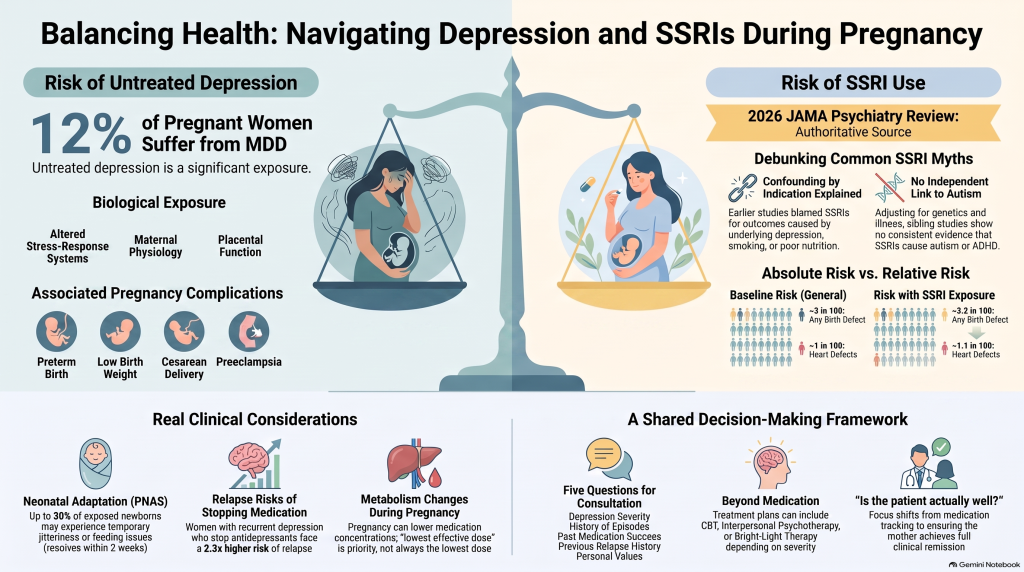 Depression During Pregnancy Is Common — and Treatable
Pregnancy is usually expected to be a happy phase of life. But depression during pregnancy is common, and many women struggle silently with persistent sadness, loss of interest, anxiety, poor sleep, fatigue, guilt or difficulty functioning.
Major depressive disorder affects about 12% of pregnant women. At the same time, around 5% to 6% of pregnant patients in the United States receive an SSRI, most commonly for depression. These numbers are not directly equivalent—some women receive psychotherapy or other treatments—but they illustrate how common depression is during pregnancy and how important access to effective perinatal mental-health care has become.
Depression during pregnancy is not simply an emotional problem that can always be postponed until after delivery.
Untreated or undertreated depression can affect:
- sleep and appetite
- motivation and self-care
- nutrition
- relationships
- ability to attend prenatal appointments
- management of other medical illnesses
- preparation for childbirth
- breastfeeding and newborn care
- overall quality of life
Maternal depression is also associated with measurable pregnancy complications. Studies summarized in a major 2026 JAMA Psychiatry review found higher rates of preterm birth, low birth weight, cesarean delivery and hyperemesis gravidarum among women with major depression. Depressive symptoms have also been associated with an increased risk of hypertension and preeclampsia.
The effects may extend beyond pregnancy. Prenatal maternal depression and stress have been associated with changes in fetal and infant neurodevelopment, emotional regulation, sleep and later childhood mental-health outcomes.
Yet many pregnant women are understandably worried about antidepressants.
Common questions include:
“Will an SSRI harm my baby?”
“Can antidepressants cause birth defects?”
“Do SSRIs increase autism risk?”
“Should I stop my antidepressant because I am pregnant?”
This fear can itself contribute to a treatment gap. The 2026 review highlights the need for better access to perinatal mental-health care, especially in areas where psychiatric and maternity services are limited, and recommends structured discussions about both the risks of untreated illness and the risks of medication exposure.
The key point is simple:
Pregnancy is not a choice between taking an SSRI and having “no exposure.”
The real comparison is often between:
the possible risks of antidepressant treatment
and
the known risks of untreated or undertreated maternal depression.
A major 2026 Special Communication published in JAMA Psychiatry, “Depression and SSRI Treatment During Pregnancy—Prioritizing Maternal Mental Health,” reviewed the evidence in detail.
Its overall conclusion is reassuring: once the effects of maternal depression and related factors are separated from the effects of medication, SSRIs appear to carry little or no additional risk for most serious pregnancy and childhood outcomes. The authors argue that treatment of maternal depression should remain a priority during pregnancy.
So what does the evidence actually show?
Why Untreated Depression During Pregnancy Matters
For many years, research concentrated heavily on the possible effects of antidepressants on the fetus.
But this creates an incomplete picture.
The fetus is not exposed only to medication. It is also exposed to the biological environment created by the mother’s health.
Major depression can influence:
- stress-response systems
- sleep
- nutrition
- health behaviours
- maternal physiology
- placental function
- engagement with prenatal care
The JAMA review emphasizes that maternal MDD itself must be considered an exposure.
This changes how antidepressant safety should be discussed.
Stopping medication may reduce drug exposure, but if significant depression returns, the mother and fetus are then exposed to active depressive illness.
There is therefore no completely risk-free option.
Why Some Older Studies Made SSRIs Look More Dangerous
One of the most important ideas in understanding SSRI pregnancy safety is something called confounding by indication.
The concept is simple.
Imagine comparing:
Pregnant women taking antidepressants
with
healthy pregnant women taking no psychiatric medication.
These groups are already different before medication is considered.
Women who continue antidepressants during pregnancy are more likely to have:
- severe depression
- recurrent depression
- chronic psychiatric illness
- other medical problems
- smoking or substance use
- obesity or poor nutrition
- socioeconomic difficulties
- reduced engagement with prenatal care
Many of these factors can independently affect pregnancy outcomes.
If researchers do not adjust properly for them, a complication may appear to be caused by the antidepressant when it may actually be related to the underlying illness or associated factors.
The review notes that women who remain on SSRIs during pregnancy often have more severe or recurrent illness than women who discontinue treatment.
This explains why better-designed modern studies often find much smaller risks than earlier studies.
Do SSRIs During Pregnancy Cause Birth Defects?
This is probably the most common concern.
Earlier studies suggested that first-trimester SSRI exposure might increase congenital heart defects.
However, larger studies with better adjustment produced a more reassuring picture.
When researchers accounted for maternal depression and other maternal characteristics, much of the apparent excess risk disappeared.
The JAMA review uses cardiac malformations as a clear example of how confounding can make medication appear more dangerous than it actually is.
Absolute Risk Matters More Than Headlines
A very useful figure in the paper presents risks in simple numbers.
For any birth defect:
- Baseline risk: about 3 in 100
- With antidepressant exposure: about 3.2 in 100
For heart defects:
- Baseline risk: about 1 in 100
- With antidepressant exposure: about 1.1 in 100
The difference is much smaller than many patients imagine when they hear that a medication may “increase risk.”
This is why good pregnancy counselling should use absolute risk, not just relative risk.
Do SSRIs in Pregnancy Cause Autism?
Another major concern is the possible link between SSRIs in pregnancy and autism.
Some early observational studies reported higher autism rates among antidepressant-exposed children.
But autism and maternal depression share genetic and environmental risk factors.
When researchers used stronger study designs—including adjustment for maternal psychiatric illness, comparison with women who discontinued antidepressants, and sibling comparisons—the association became much weaker or disappeared.
Sibling analyses produced essentially null findings for several neurodevelopmental outcomes, including:
- autism spectrum disorder
- ADHD
- learning disability
- intellectual disability
- language disorders
- behavioural disorders
Overall, the review concludes that studies have not shown consistent evidence that prenatal SSRI exposure independently causes long-term neurodevelopmental disorders.
The important lesson is:
Association does not automatically mean causation.
What About Brain Development?
Some neuroimaging studies have reported small differences in brain structure among children exposed to SSRIs during fetal life.
Areas reported include parts of the:
- corticolimbic system
- amygdala
- fusiform gyrus
- parietal cortex
- occipital cortex
However, interpretation is difficult because maternal depression itself can also affect brain development.
Some differences become less obvious with age, effect sizes may be small, and their functional significance remains uncertain.
The review therefore does not support interpreting these imaging findings as proof that SSRIs cause clinically meaningful brain injury.
Poor Neonatal Adaptation Syndrome After SSRIs
One genuine issue associated with SSRI exposure, especially later in pregnancy, is poor neonatal adaptation syndrome, or PNAS.
It may include:
- jitteriness
- irritability
- respiratory difficulty
- fast heart rate
- feeding problems
- increased need for neonatal observation
The review reports that these symptoms may occur in up to 30% of newborns exposed to SSRIs before birth.
However, an important point is often missed:
PNAS is usually temporary.
In most cases it resolves with supportive care, generally within about two weeks.
The risk appears greater when SSRIs are combined with benzodiazepines.
So PNAS is a real consideration, but it is very different from saying that SSRIs commonly cause permanent harm.
SSRIs and Persistent Pulmonary Hypertension of the Newborn
Persistent pulmonary hypertension of the newborn, or PPHN, is another possible complication discussed in relation to SSRIs.
The review reports an adjusted odds ratio of:
1.28
for PPHN associated with SSRI exposure.
This suggests a small relative increase.
But because PPHN itself is uncommon, the absolute risk remains low.
Again, this risk should be considered alongside the consequences of leaving significant maternal depression untreated.
Should Antidepressants Be Stopped When Pregnancy Is Confirmed?
Not automatically.
Stopping an effective antidepressant simply because pregnancy has started can lead to:
- discontinuation symptoms
- relapse of depression
- worsening anxiety
- disturbed sleep
- reduced functioning
- psychiatric emergencies in vulnerable patients
This becomes especially important in women with severe or recurrent depression.
A meta-analysis discussed in the review found that among women with severe or recurrent depression, stopping antidepressants was associated with a significantly higher relapse risk:
Risk ratio 2.30.
Therefore, pregnancy itself is not enough reason to discontinue successful treatment.
Who Needs Extra Caution Before Stopping an SSRI?
Discontinuation requires particular caution when there is a history of:
- multiple depressive episodes
- severe depression
- previous hospitalization
- suicidal behaviour
- chronic depression
- previous relapse after stopping medication
- major functional impairment
For these women, maintaining psychiatric stability may be extremely important.
Should SSRIs Be Stopped Just Before Delivery?
Not routinely.
Late pregnancy and the postpartum period are also periods when some women are vulnerable to recurrence of depression.
Stopping an antidepressant simply to reduce neonatal adaptation symptoms may therefore create another problem: maternal relapse around delivery or shortly after childbirth.
The decision should be individualized rather than automatic.
Should the Antidepressant Dose Be Reduced During Pregnancy?
Another common belief is that every pregnant woman should take the lowest possible dose.
A more useful principle is:
Use the lowest effective dose that keeps the patient well.
Pregnancy changes drug metabolism.
The JAMA review notes that pregnancy can lower plasma concentrations of some antidepressants, potentially reducing their effectiveness.
Therefore, unnecessarily reducing the dose may increase the risk of relapse.
The goal should not simply be to minimize the number written on the prescription.
The goal is to maintain remission with an effective and well-tolerated treatment plan.
Psychotherapy Is Also Important
SSRIs are not the only treatment for depression during pregnancy.
The review discusses effective psychological treatments including:
- cognitive behavioural therapy
- interpersonal psychotherapy
- behavioural activation
Other options studied during pregnancy include:
- bright-light therapy
- transcranial magnetic stimulation
- electroconvulsive therapy
Treatment should depend on the severity of depression.
For mild illness, psychotherapy may sometimes be sufficient.
For moderate, severe or recurrent depression, medication may be an important part of treatment.
The aim should be remission, not medication avoidance at any cost.
A Simple Approach to SSRI Treatment During Pregnancy
A practical discussion can start with five questions.
1. How severe is the depression?
Mild symptoms are very different from severe depression with major functional impairment or suicidal thoughts.
2. How many previous episodes has the patient had?
Repeated episodes generally suggest a greater relapse risk.
3. What happened when medication was stopped previously?
Previous relapse after discontinuation is important information.
4. Is the current antidepressant actually working?
A medication that has maintained good remission should not be changed casually.
5. What matters most to the patient?
Some patients strongly wish to minimize medication exposure.
Others are particularly concerned about experiencing another severe depressive episode.
Both concerns deserve a proper discussion.
The JAMA review recommends shared decision-making and explaining risks in absolute numbers whenever possible, while also acknowledging uncertainty.
Monitoring Depression During Pregnancy
Treatment should not end with simply prescribing or stopping an antidepressant.
Symptoms should be monitored throughout pregnancy and after delivery.
The review supports approaches such as:
- collaborative care
- algorithm-guided treatment
- repeated assessment of symptom severity
- validated rating scales
- treatment adjustment when symptoms change
These strategies can improve remission rates.
In practical psychiatry, the important question is not merely:
“Is the patient taking medication?”
It is:
“Is the patient actually well?”
Frequently Asked Questions About SSRIs in Pregnancy
Are SSRIs safe during pregnancy?
Current evidence suggests that SSRIs are an important treatment option during pregnancy and carry little or no additional risk for most serious outcomes once maternal depression and other confounding factors are properly considered.
Do SSRIs cause birth defects?
Modern evidence does not support SSRIs as major causes of congenital malformations. Earlier associations became much weaker after researchers adjusted for maternal depression and other factors.
Do antidepressants cause autism?
Current evidence does not establish prenatal SSRI exposure as an independent cause of autism.
Can SSRIs affect the newborn after delivery?
Yes. Temporary poor neonatal adaptation symptoms can occur, particularly after late-pregnancy exposure. Most cases are self-limited.
Is untreated depression during pregnancy dangerous?
It can be. Maternal depression is associated with adverse maternal, pregnancy and childhood outcomes and can significantly impair functioning.
Should an antidepressant be stopped as soon as pregnancy is confirmed?
No. Medication should not be stopped automatically. The risks of relapse and untreated illness should first be assessed.
Is there a completely risk-free option?
No.
This is perhaps the most important message.
Pregnancy involves balancing the potential risks of treatment against the risks of untreated illness.
The Bottom Line on SSRIs and Pregnancy
The 2026 JAMA Psychiatry review represents an important shift in how antidepressants during pregnancy should be understood.
For years, the discussion focused mainly on:
“What might the medication do to the baby?”
The better question is:
“Which treatment strategy gives both mother and baby the best chance of remaining healthy?”
Current evidence suggests that:
- Depression during pregnancy is common and clinically important.
- Untreated maternal depression is associated with adverse pregnancy and developmental outcomes.
- SSRIs are not major teratogens based on current evidence.
- Associations between prenatal SSRI exposure and autism or other neurodevelopmental disorders become much weaker after controlling for maternal illness and family factors.
- Poor neonatal adaptation can occur but is usually temporary.
- PPHN may be slightly increased, but the absolute risk remains low.
- Women with severe or recurrent depression may have a substantially greater risk of relapse if effective antidepressants are stopped.
- Antidepressants should therefore not be discontinued automatically because of pregnancy.
The goal of treatment should not be simply to avoid medication.
The goal should be:
a mentally healthy mother, a healthy pregnancy and the best possible environment for the developing child.
Depression and Pregnancy Psychiatric Consultation in Chennai
Women who are planning pregnancy, currently pregnant or entering the postpartum period may benefit from a structured psychiatric review before stopping, reducing or changing antidepressant treatment.
A psychiatric assessment can include:
- severity of depression and anxiety
- previous depressive episodes
- previous response to antidepressants
- relapse risk
- risks and benefits of continuing treatment
- psychological treatment options
- monitoring throughout pregnancy
- postpartum relapse-prevention planning
Dr. Srinivas Rajkumar T, MD (AIIMS New Delhi), DNB, MBA (BITS Pilani)
Senior Consultant Psychiatrist
Mind & Memory Clinic, Apollo Clinic Velachery, Chennai — Opp. Phoenix Mall
Patients already taking antidepressants should ideally discuss treatment with their psychiatrist and obstetric team