The Relationships We Carry Within: Understanding Transference, Enactments, and Object Relations in Psychotherapy
 Why do we sometimes feel powerless in relationships, only to become angry and controlling moments later? Why do people push away the very individuals from whom they seek love, understanding, and acceptance? The answers may lie in the unconscious relationships we carry within ourselves.
The Invisible Relationships That Shape Our Lives
Human relationships are rarely as straightforward as they appear.
We often assume that our emotional reactions are direct responses to what another person has said or done. Yet our experiences of others are influenced not only by their actual behaviour but also by our memories, expectations, emotional vulnerabilities, and internal representations of relationships.
A person may experience a relatively ordinary disagreement as profound rejection. Someone who desperately wants emotional closeness may become hostile when another person begins to matter to them. A patient may initially idealize a therapist as uniquely understanding, only to become deeply disappointed or contemptuous following a minor frustration.
These seemingly contradictory responses raise an important psychological question: Are we always responding to the person in front of us, or are we sometimes responding to an internal relationship that existed long before the present encounter?
Object relations theory offers a compelling framework for exploring this question.
Developed through the contributions of psychoanalytic thinkers including Melanie Klein, Ronald Fairbairn, Donald Winnicott, and Otto Kernberg, object relations theory proposes that our experiences of important relationships become internalized as psychological representations.
These representations influence how we experience ourselves, how we perceive others, and how we respond emotionally within relationships.
In contemporary psychodynamic psychotherapy, particularly Transference-Focused Psychotherapy (TFP), these internal relationships become important subjects of therapeutic exploration.
We Carry Representations of Ourselves and Others
Imagine a child who repeatedly experiences a caregiver as unpredictable, critical, or emotionally unavailable.
Over time, the child may develop an internal relational pattern in which they experience themselves as inadequate, helpless, or undeserving, while the other person is experienced as powerful, rejecting, or critical.
This does not mean that every difficult childhood experience produces a fixed personality pattern. Temperament, resilience, subsequent relationships, and many other developmental factors influence psychological outcomes.
Nevertheless, early and repeated relational experiences can contribute to enduring expectations about how relationships work.
Object relations theory describes these internal experiences through the concept of an object relations dyad.
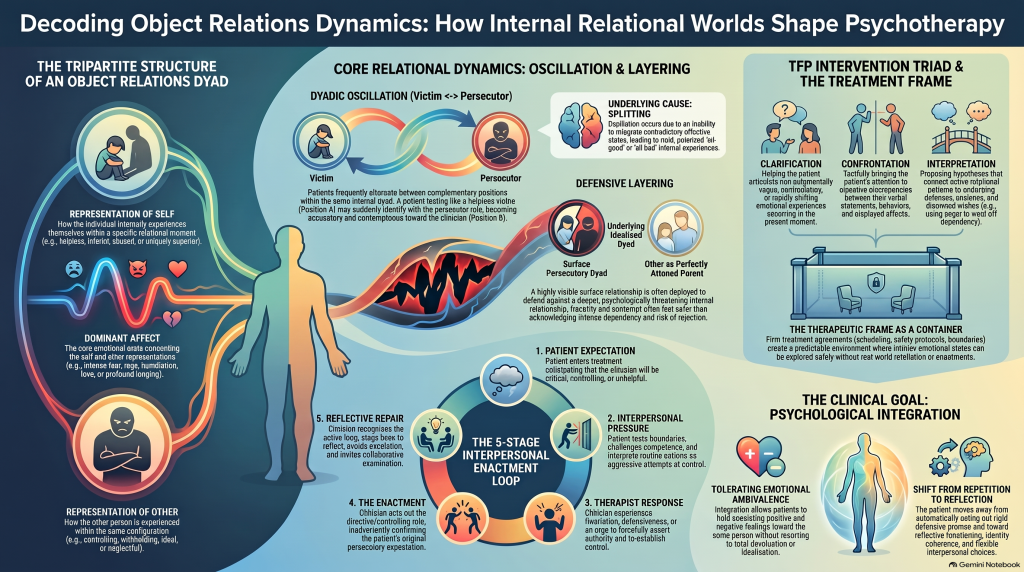
A dyad contains three interconnected elements: a representation of the self, a representation of another person, and the emotional state connecting them.
For example, a person may experience themselves as helpless and inferior, the other person as powerful and persecutory, and the relationship as dominated by anxiety or fear.
Alternatively, the same individual may experience themselves as powerful and superior, while viewing the other person as weak, incompetent, or deserving of criticism. The dominant emotion may then become indignation, contempt, or rage.
What is particularly interesting is that these apparently opposite experiences may represent different positions within the same internal relational configuration.
From Victim to Persecutor: How Relationships Can Reverse
One of the most clinically interesting illustrations in the work of Stern and Yeomans involves the oscillation of object relations dyads.
Consider a patient who enters a consultation feeling anxious and vulnerable.
The patient may believe that the psychiatrist is judging them, controlling their decisions, or failing to understand their difficulties.
In that moment, the patient experiences themselves as the inferior victim and the psychiatrist as the superior persecutor.
The emotional experience is dominated by fear, anxiety, and helplessness.
Yet the interaction may change dramatically.
The patient may suddenly become critical of the psychiatrist’s competence, question their qualifications, or accuse them of being ineffective.
The psychiatrist, previously experienced as powerful and intimidating, is now treated as inferior or incompetent.
The patient has moved into the superior, persecutory position.
The dominant emotion has shifted from fear to anger or contempt.
This movement is not simply a change in mood.
From an object relations perspective, the patient has shifted between complementary identifications within an internal relational dyad.
The person who initially experienced themselves as persecuted may now identify with the persecutor.
These shifts can be particularly prominent in individuals who struggle to integrate conflicting emotional experiences of themselves and others.
Importantly, such dynamics are not exclusive to personality disorders, and criticism of a clinician should never automatically be interpreted as psychopathology. The clinician must always consider whether the patient’s concerns are justified.
Splitting: When Good and Bad Experiences Cannot Coexist
Most mature relationships involve ambivalence.
We can love someone while feeling disappointed with them. We can recognize another person’s strengths while acknowledging their limitations. We can experience anger without concluding that the entire relationship is worthless.
This capacity depends partly on our ability to integrate positive and negative experiences into a relatively stable representation of ourselves and others.
In psychodynamic theory, splitting refers to a defensive process in which contradictory emotional representations remain insufficiently integrated.
For example, a patient may experience a therapist as exceptionally caring and understanding during one session.
After a disagreement, the same therapist may suddenly be experienced as entirely uncaring, manipulative, or incompetent.
The patient’s earlier positive experiences may become emotionally inaccessible during the moment of anger.
When the relationship improves, the positive representation may return.
The difficulty is not necessarily an inability to intellectually recognize complexity. Rather, strongly activated emotional states can interfere with the person’s ability to maintain a balanced experience of the relationship.
In Kernberg’s model, persistent reliance on splitting and related defenses is associated with difficulties in identity integration and personality functioning.
The therapeutic goal is not to eliminate negative emotions but to help the individual tolerate contradictory feelings without experiencing the relationship as entirely good or entirely bad.
The Relationship Beneath the Conflict
A second important concept illustrated by Stern and Yeomans is the layering of object relations dyads.
Sometimes the relationship most visible during a clinical encounter may conceal another, more vulnerable relational experience.
Imagine a patient who repeatedly experiences their therapist as critical, rejecting, or controlling.
The surface relationship appears persecutory. The patient feels inferior and frightened, or alternatively becomes angry and contemptuous.
However, beneath this relationship there may be an intensely idealized representation.
The patient may unconsciously long to experience themselves as a good, deserving child in the presence of a perfectly loving, understanding, and validating caregiver.
The dominant emotion within this underlying relationship is longing.
Why would such a desirable relationship need to be defended against?
Because acknowledging the wish for perfect care can also mean acknowledging dependency.
For some individuals, particularly those with significant narcissistic vulnerability, dependency may evoke shame, humiliation, fear of rejection, or a sense of inferiority.
It may feel psychologically safer to criticize the person whose care is desired than to acknowledge how much that care matters.
Sometimes anger protects us from vulnerability. Sometimes contempt protects us from dependency. And sometimes the rejection of another person conceals an intense longing to be understood by them.
This is one possible psychodynamic formulation, not a universal explanation for interpersonal hostility.
Narcissistic Vulnerability and the Fear of Needing Others
Narcissism is often understood in popular discussions as excessive self-love or arrogance.
Clinically, narcissistic functioning can be considerably more complex.
Some individuals display overt grandiosity, entitlement, or superiority. Others experience profound vulnerability, shame, sensitivity to criticism, and unstable self-esteem.
These experiences can coexist or alternate.
A person may intensely desire admiration and emotional recognition while simultaneously resenting the dependency involved in seeking them.
For example, a patient may initially idealize a psychiatrist as exceptionally capable.
As treatment progresses, the patient begins to feel emotionally dependent on the therapeutic relationship.
A missed expectation or unavoidable limitation may then provoke disproportionate disappointment.
The patient may respond by devaluing the psychiatrist.
Within an object relations formulation, devaluation may serve to protect the individual from the vulnerability of needing someone perceived as important.
The underlying psychological conflict is not necessarily between loving and hating another person. It may involve the difficulty of maintaining self-esteem while acknowledging emotional dependence.
Recognizing this distinction can be clinically useful, especially when apparently hostile behaviour repeatedly emerges in situations involving closeness, trust, or dependency.
Transference: When the Past Becomes Present
The therapeutic relationship provides a particularly interesting setting in which these internal relational patterns may emerge.
In psychodynamic psychotherapy, transference refers to the activation of emotional expectations and internalized relational patterns within the therapeutic relationship.
A patient who has repeatedly experienced authority figures as controlling may anticipate similar behaviour from the psychiatrist.
A patient who expects abandonment may become intensely anxious when an appointment is rescheduled.
Another patient may idealize the therapist as someone who will finally provide the perfect understanding that has been missing from previous relationships.
These experiences can feel entirely real to the patient.
Transference does not imply that the patient’s perceptions are imaginary or that the therapist’s actual behaviour is irrelevant.
Rather, it highlights how present relationships are experienced through a combination of current reality and established psychological expectations.
The psychiatrist’s task is to distinguish between these influences while maintaining empathy, curiosity, and appropriate therapeutic boundaries.
Countertransference: What Happens Inside the Therapist?
Psychotherapy is not a one-way psychological process.
The therapist also experiences emotions during treatment.
A patient who repeatedly presents as helpless may evoke an unusually strong desire to rescue them.
A patient who constantly questions the psychiatrist’s competence may evoke defensiveness, frustration, or a need to assert authority.
A patient who idealizes the therapist may evoke gratification or a sense of exceptional responsibility.
These emotional responses are relevant to the concept of countertransference.
Contemporary psychodynamic approaches recognize that the therapist’s emotional experience may provide information about the interpersonal processes unfolding during treatment.
However, the therapist’s feelings are not necessarily caused by the patient’s unconscious processes.
They may also reflect the clinician’s personality, personal history, fatigue, institutional pressures, or actual difficulties in the therapeutic relationship.
The value of countertransference lies in the therapist’s capacity to reflect upon these experiences rather than automatically act on them.
A psychiatrist who notices an urge to become unusually controlling may ask why that response has emerged and whether it is contributing to an unhelpful relational pattern.
This capacity for self-observation is particularly important in emotionally demanding clinical encounters.
Projective Identification: When Others Are Drawn Into Our Internal World
Projective identification is another influential concept within object relations theory.
Unlike simple projection, in which an individual attributes unwanted feelings or characteristics to another person, projective identification describes a more complex psychological and interpersonal process.
A person may relate to someone in ways that evoke or reinforce a particular emotional role.
For example, a patient who expects authority figures to be controlling may repeatedly challenge the psychiatrist’s decisions.
The psychiatrist may begin to feel frustrated and respond with increasing rigidity.
The patient then experiences the psychiatrist as controlling, confirming their original expectation.
The interaction becomes self-reinforcing.
This does not mean that emotions are literally transferred from one person’s mind into another.
Rather, projective identification offers a theoretical framework for understanding how defensive expectations and interpersonal behaviour may influence the emotional responses of others.
The concept is clinically influential, although its precise mechanisms remain difficult to operationalize and empirically establish.
Enactments: When Both People Become Part of the Same Drama
One of the most fascinating developments in contemporary psychodynamic thinking is the concept of enactment.
An enactment occurs when a relational pattern becomes expressed through the interaction between patient and therapist, sometimes without either participant fully recognizing what is happening.
Consider a hypothetical patient who enters therapy expecting to be criticized and controlled.
The patient repeatedly challenges the therapist’s recommendations.
The therapist begins to feel that their professional competence is being questioned.
In response, the therapist becomes more directive, explains decisions more forcefully, and insists on maintaining control of the consultation.
The patient experiences this as confirmation that the therapist is authoritarian.
The therapist, meanwhile, feels increasingly frustrated by what appears to be unreasonable resistance.
Both individuals have become involved in a relational pattern that resembles the patient’s original expectations.
The therapist is no longer merely observing the patient’s internal world.
The therapist has become a participant in an interaction that may reproduce aspects of it.
Recognizing an enactment creates an opportunity to change the process.
The therapist may notice the growing struggle for control and become curious about how the interaction developed.
Instead of defending professional authority, the therapist can explore the patient’s experience while reflecting on their own contribution.
This is one of the ways psychotherapy can transform an automatic interpersonal pattern into something that can be consciously understood.
Enactments are not necessarily evidence of poor therapeutic practice. The important issue is whether they can be recognized, examined, and repaired.
How Transference-Focused Psychotherapy Addresses These Patterns
Transference-Focused Psychotherapy, developed from Otto Kernberg’s object relations model, is a structured psychodynamic treatment particularly associated with borderline personality pathology.
TFP seeks to help patients recognize and integrate polarized representations of themselves and others.
The therapeutic relationship becomes an important setting for identifying these patterns.
The approach relies on several central techniques.
Clarification helps the patient describe their emotional experience more precisely.
Confrontation, in the technical psychodynamic sense, involves drawing attention to contradictions or discrepancies without hostility or humiliation.
Interpretation explores possible connections between the patient’s emotional experience, defensive processes, and recurring relational patterns.
For example, a therapist might help a patient recognize that feeling dependent is repeatedly followed by anger and devaluation.
Rather than immediately interpreting this as a defense against vulnerability, the therapist may first explore what happened, how the patient experienced the interaction, and what emotions accompanied the change.
Over time, the patient may become better able to recognize these patterns.
The therapeutic aim is to develop a more coherent sense of self, improve affect regulation, tolerate ambivalence, and sustain more stable interpersonal relationships.
TFP also emphasizes the importance of a clearly established treatment frame, including appropriate boundaries, shared responsibilities, and attention to safety.
Why These Concepts Matter Beyond Personality Disorders
Although these ideas are particularly relevant to personality pathology, their broader clinical value extends across psychiatry and psychotherapy.
Patients with depression may interpret interpersonal experiences through persistent expectations of rejection, guilt, or worthlessness.
Patients with trauma-related difficulties may experience certain relational situations as threatening because of earlier experiences.
Individuals struggling with chronic illness may find dependency particularly distressing.
Patients with substance use disorders may experience treatment boundaries through complex emotions involving shame, autonomy, trust, and control.
However, similar behaviours can arise from very different causes.
An apparently difficult interaction may reflect anxiety, neurodevelopmental differences, cognitive impairment, medication effects, cultural misunderstanding, psychosis, or genuine dissatisfaction with care.
Psychodynamic concepts should therefore complement a comprehensive biopsychosocial assessment rather than replace it.
Not every disagreement is transference. Not every angry patient is engaging in projective identification. Not every therapeutic rupture reflects personality pathology.
Good psychiatric practice requires the clinician to remain open to multiple explanations.
What Does Scientific Research Tell Us?
Object relations theory has substantially influenced contemporary understandings of personality and psychotherapy.
Research on attachment, personality functioning, emotional regulation, and interpersonal expectations supports the broader observation that individuals develop relatively enduring patterns of experiencing themselves and others.
TFP has also been investigated in randomized clinical trials involving borderline personality disorder, with studies reporting improvements across several clinical domains.
Other structured approaches, including Dialectical Behaviour Therapy, Mentalization-Based Treatment, and Schema Therapy, also have evidence supporting their effectiveness.
No single approach is universally superior for every patient.
It is also important to distinguish evidence for a psychotherapy’s clinical effectiveness from evidence validating each theoretical mechanism proposed to explain its effects.
Concepts such as persecutory dyads, defensive layering, and projective identification remain valuable clinical formulations, but they are not directly established neurobiological mechanisms or diagnostic biomarkers.
Their usefulness depends on whether they help clinicians understand patients more accurately, formulate meaningful interventions, and improve therapeutic outcomes.
From Repetition to Reflection: The Real Goal of Psychotherapy
Perhaps the most important contribution of object relations theory is its explanation of why people sometimes repeatedly experience similar difficulties across very different relationships.
A person who expects rejection may become defensive in ways that distance others.
Someone who fears dependency may reject help when it becomes emotionally meaningful.
A person who anticipates humiliation may attempt to establish superiority before another person can criticize them.
These patterns can become repetitive and self-reinforcing.
Psychotherapy provides an opportunity to recognize them within a consistent and reflective relationship.
The aim is not to blame the patient for their difficulties or reduce every emotional experience to childhood relationships.
It is to help the person understand how established psychological expectations may influence their present experiences.
As these patterns become more recognizable, patients may develop greater freedom to respond differently.
They may learn to tolerate disappointment without experiencing complete rejection, acknowledge dependency without humiliation, and experience anger without losing the capacity for affection.
The movement is from rigid, polarized relational experiences toward greater psychological integration.
Final Thoughts: Sometimes We Are Fighting Relationships That Exist Within Us
The concepts of oscillation and layering of object relations dyads remind us that interpersonal conflicts are not always explained by the immediate interaction alone.
A patient who appears angry may also be frightened.
Someone who seems contemptuous may be struggling with dependency.
A person who rejects care may simultaneously long for an idealized relationship in which they feel completely understood.
The challenge for the psychiatrist or psychotherapist is to look beyond the visible emotion without dismissing it.
This requires curiosity, empathy, psychological sophistication, and an awareness of the clinician’s own emotional responses.
It also requires recognizing that the therapeutic relationship is a real relationship, not merely a stage upon which the patient’s unconscious conflicts are performed.
Sometimes the therapist makes mistakes. Sometimes the patient’s anger is justified. Sometimes a relational pattern reflects a combination of both participants’ contributions.
The most meaningful therapeutic work emerges when these possibilities can be explored without defensiveness or blame.
Psychotherapy is not merely about understanding what happened to us in the past. It is also about recognizing how the relationships we carry within ourselves continue to shape the relationships we create today.
And perhaps one of the most important achievements of psychotherapy is helping individuals discover that the patterns they have repeatedly lived through do not have to determine every relationship in their future.
About the Author
Dr. Srinivas Rajkumar T
MBBS, MD Psychiatry (AIIMS New Delhi), DNB Psychiatry, MBA
Senior Consultant Psychiatrist | Chennai
Dr. Srinivas Rajkumar is a Chennai-based consultant psychiatrist with postgraduate training in Psychiatry from the All India Institute of Medical Sciences (AIIMS), New Delhi.
His clinical practice emphasizes comprehensive biopsychosocial assessment, evidence-informed psychiatric treatment, and an individualized understanding of the psychological, biological, and interpersonal factors contributing to mental health difficulties.
His professional interests include adult ADHD, mood and anxiety disorders, obsessive-compulsive disorder, personality pathology, psychodynamic psychotherapy, neuropsychiatry, and interventional psychiatry.
He has experience with psychotherapy approaches including Cognitive Behaviour Therapy (CBT), Dialectical Behaviour Therapy (DBT), Schema Therapy, and Mentalization-Based approaches, alongside biological interventions such as rTMS, tDCS, ECT, and ketamine-based treatment.
A particular area of his academic interest is the integration of clinical psychiatry with emerging technologies, including quantitative EEG (qEEG), neurofeedback, cognitive assessments, and AI-assisted approaches to psychiatric evaluation and treatment monitoring.
His approach is rooted in the belief that effective psychiatric care requires more than identifying symptoms. It involves understanding the person, their developmental experiences, their relationships, and the biological and psychological processes influencing their mental health.
Consultations in Chennai
Dr. Srinivas Rajkumar T
Senior Consultant Psychiatrist
Apollo Clinic, Velachery, Chennai (Near Phoenix Marketcity)
Ph: 8595155808
For consultations relating to emotional difficulties, relationship patterns, personality functioning, adult ADHD, depression, anxiety, or other psychiatric concerns, appointments can be arranged through the clinic.
Website: https://srinivasaiims.com
Psychiatry is not merely the treatment of symptoms. It is the science and art of understanding the person experiencing them.