Childhood OCD: Recognising the Early Signs and Helping Children Recover
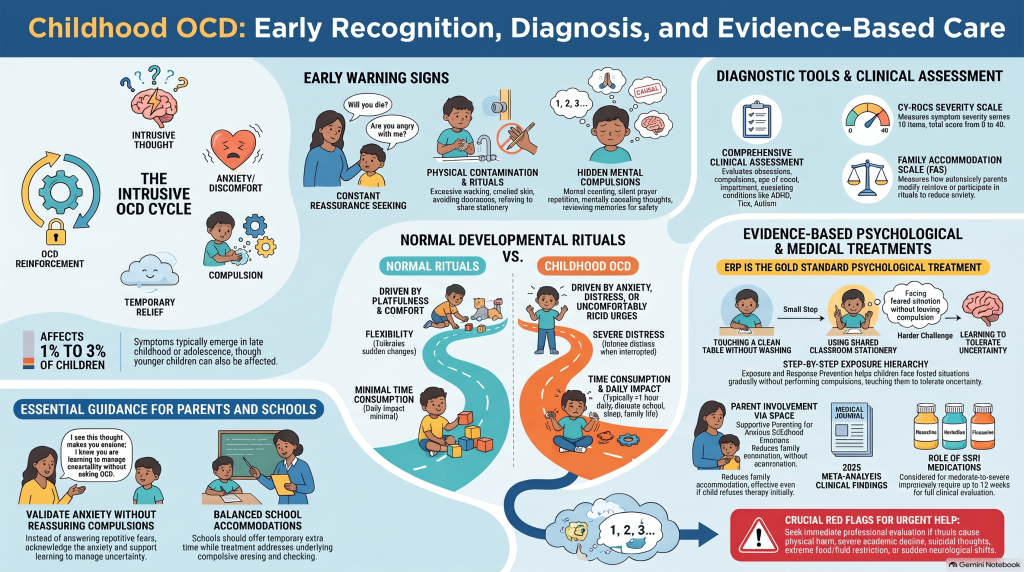 1. What Is Childhood OCD?
Obsessive-Compulsive Disorder (OCD) is a psychiatric condition characterised by obsessions, compulsions, or both.
Obsessions are recurrent, unwanted thoughts, images or urges that cause distress.
Compulsions are repetitive behaviours or mental acts performed to reduce anxiety, neutralise an obsession or prevent a feared event.
For example, a child might worry that something terrible will happen to their mother unless they touch the door exactly four times before leaving home.
The child may understand that this makes little sense, but the anxiety associated with not performing the ritual can feel overwhelming.
A characteristic cycle develops:
Intrusive thought → Anxiety or discomfort → Compulsion → Temporary relief → Reinforcement of OCD
Over time, compulsions may become more elaborate and time-consuming.
OCD is not simply a preference for cleanliness, order or perfection. It is a condition in which thoughts and rituals begin to control the child’s behaviour.
2. How Common Is Childhood OCD?
OCD affects approximately 1–3% of children and adolescents, although prevalence estimates vary between studies and populations.
Symptoms commonly begin in late childhood or adolescence, but OCD can also occur in younger children.
Childhood-onset OCD is sometimes associated with:
- A family history of OCD or related conditions.
- Tic disorders or Tourette syndrome.
- Anxiety disorders.
- Attention-deficit/hyperactivity disorder (ADHD).
- Autism spectrum disorder (ASD).
- Depression and emotional difficulties.
Not all children with repetitive behaviours have OCD. The meaning, function and consequences of the behaviour are crucial to diagnosis.
3. Early Warning Signs: What Parents Should Notice
Childhood OCD can appear differently from adult OCD because young children may struggle to describe their intrusive thoughts.
Parents often first notice behavioural changes.
A. Repeated questioning and reassurance seeking
A child may repeatedly ask:
- “Will you die?”
- “Are you sure nothing bad will happen?”
- “Did I say something wrong?”
- “Am I a bad person?”
- “Are you angry with me?”
Even after receiving reassurance, the child may ask the same question again.
The problem is not necessarily a lack of understanding. Reassurance temporarily reduces anxiety but may become part of the compulsive cycle.
B. Excessive washing and contamination fears
Children may:
- Wash their hands repeatedly.
- Avoid touching doorknobs or school objects.
- Refuse to share toys or stationery.
- Change clothes excessively.
- Avoid public toilets.
- Become distressed when others touch their belongings.
Some children develop cracked or irritated skin because of repeated washing.
C. Repeating, counting and arranging
A child may insist on:
- Walking through a doorway several times.
- Touching objects in a particular sequence.
- Counting silently before starting an activity.
- Arranging toys symmetrically.
- Repeating words until they feel right.
- Performing actions an even number of times.
These behaviours may be accompanied by a powerful sense that something is incomplete or not quite right.
D. Excessive perfectionism in schoolwork
Not all perfectionism is OCD.
However, concern arises when a child repeatedly erases and rewrites answers, cannot submit assignments because of minor imperfections, or spends hours completing simple tasks.
Some children insist that individual letters must look identical or that handwriting must feel exactly right.
Teachers may misinterpret these behaviours as slowness, inattention or oppositionality.
E. Bedtime rituals
A child may insist that parents repeat goodnight messages in a specific way or check doors and windows repeatedly.
Bedtime routines may become progressively longer.
The child may also insist that family members perform actions in a particular sequence.
F. Hidden compulsions
Some of the most impairing OCD symptoms are invisible.
These include:
- Mental counting.
- Repeating prayers silently.
- Reviewing memories to check whether something inappropriate happened.
- Mentally cancelling a disturbing thought.
- Repeatedly checking one’s intentions or feelings.
A child with primarily mental compulsions may appear distracted, withdrawn or unusually slow rather than overtly ritualistic.
4. Normal Childhood Rituals Versus OCD
Young children naturally enjoy repetition, predictable routines and familiar rituals.
A bedtime story, a lucky pencil or arranging favourite toys does not automatically indicate OCD.
The critical difference is the degree of distress, rigidity and functional impairment.
| Normal developmental behaviour | Possible OCD |
|---|---|
| Enjoys a familiar routine | Feels compelled to repeat a ritual |
| Can usually tolerate changes | Becomes intensely distressed when interrupted |
| Behaviour is playful or comforting | Behaviour is driven by anxiety or an uncomfortable urge |
| Takes little time | Becomes time-consuming |
| Rarely disrupts family life | Interferes with school, sleep or relationships |
Clinically significant OCD commonly involves substantial time consumption, often more than one hour daily, or marked distress or impairment. A child need not spend an hour on rituals to warrant evaluation if functioning is clearly affected.
5. Why Children Often Hide Their OCD
OCD is frequently associated with embarrassment and shame.
Children may recognise that their fears seem unusual and therefore avoid discussing them.
Others believe that revealing an intrusive thought might make it happen.
This is especially important in children experiencing unwanted aggressive, religious, sexual or morally disturbing thoughts.
For example, a child may experience an unwanted thought about harming a family member and become frightened by its presence.
Having an intrusive thought is not the same as wanting to act on it.
Such thoughts can occur in OCD and should be assessed sensitively rather than automatically interpreted as dangerous intentions.
Parents and clinicians should create an environment in which children can describe unusual thoughts without fear of punishment or ridicule.
6. How Is Childhood OCD Diagnosed?
Diagnosis requires a comprehensive clinical assessment.
A child psychiatrist or appropriately trained mental health professional explores:
- The nature of obsessions and compulsions.
- Age of onset and symptom progression.
- Time spent on rituals.
- Associated distress and functional impairment.
- Insight and ability to resist compulsions.
- Family involvement in rituals.
- Academic and social difficulties.
- Coexisting psychiatric or developmental conditions.
Children may not spontaneously describe obsessions. Clinicians often need developmentally appropriate questions, behavioural examples, drawings or play-based communication.
Standardised assessment tools
Children’s Yale-Brown Obsessive Compulsive Scale (CY-BOCS)
The CY-BOCS is a widely used clinician-rated measure of childhood OCD severity.
The conventional 10-item scale evaluates obsessions and compulsions across dimensions such as time, interference, distress, resistance and control.
Its total score ranges from 0 to 40.
It is useful for establishing baseline severity and monitoring progress during treatment.
Obsessive Compulsive Inventory–Child Version (OCI-CV)
This self-report instrument assesses several dimensions of obsessive-compulsive symptoms. A validated five-item brief version, OCI-CV-5, can assist initial screening.
Family Accommodation Scale (FAS)
Family accommodation measures how extensively caregivers modify their behaviour or participate in rituals because of the child’s OCD.
These instruments support assessment but do not replace clinical diagnosis.
Conditions that can resemble childhood OCD
Repetitive behaviours also occur in autism, tic disorders, anxiety disorders and other developmental conditions.
In autism, repetitive behaviours may be pleasurable, regulating or related to restricted interests, whereas OCD compulsions are often driven by feared consequences or unwanted discomfort. Both conditions can coexist.
Tics may be preceded by sensory urges rather than obsessional fears, although tic-related OCD can overlap phenomenologically.
The clinician must also consider generalised anxiety, trauma-related symptoms, eating disorders, depression and, occasionally, psychotic disorders.
7. Psychological Treatment: Exposure and Response Prevention
Cognitive Behavioural Therapy (CBT), particularly Exposure and Response Prevention (ERP), is the best-established psychological treatment for childhood OCD.
ERP helps children learn that they can experience uncertainty, anxiety or discomfort without performing compulsions.
How ERP works
Consider a child who repeatedly washes their hands after touching ordinary household objects because they fear contamination.
During therapist-guided ERP, the child might gradually practise touching a safe object and delaying or omitting unnecessary washing.
The therapist supports the child in experiencing the discomfort without escaping through a ritual.
With repeated practice, the child learns:
- Anxiety can be tolerated.
- Uncertainty does not have to be eliminated.
- Compulsions are not necessary for safety.
- Distressing thoughts do not require immediate action.
ERP is not about forcing children into overwhelming situations or exposing them to genuine dangers.
It uses collaboratively planned, developmentally appropriate exercises, usually beginning with manageable challenges.
The exposure hierarchy
The therapist and child create a hierarchy of feared situations.
For example:
- Touching a clean table without immediately washing.
- Handling an everyday schoolbook.
- Using shared classroom stationery.
- Completing ordinary activities without additional cleaning rituals.
These are illustrative exercises, not a prescription for an individual child. The hierarchy should be based on the child’s particular symptoms, developmental level and realistic hygiene needs.
8. Family-Based CBT: Why Parents Are Part of Treatment
One of the most important advances in childhood OCD treatment is recognising the role of family accommodation.
Accommodation occurs when family members participate in rituals or change normal activities to reduce the child’s distress.
Examples include:
- Answering the same reassurance question repeatedly.
- Washing objects unnecessarily.
- Following elaborate bedtime instructions.
- Avoiding ordinary activities because the child fears contamination.
- Checking homework repeatedly on the child’s behalf.
Parents usually do these things out of concern and affection.
Unfortunately, repeated accommodation can maintain OCD symptoms.
What parents can do differently
Parents can learn to validate the child’s distress without reinforcing compulsions.
For example, instead of repeatedly assuring a child that nothing bad will happen, a parent might say:
“I can see that this thought is making you anxious. We have talked about this fear, and I know you are learning to manage the uncertainty without asking OCD for another answer.”
The emphasis is on emotional support, consistency and gradual change.
Accommodation should be reduced collaboratively rather than through punishment, shaming or abrupt withdrawal of support.
9. Newer Psychological Approaches
Although ERP remains the foundation of treatment, several approaches can complement conventional CBT or improve access.
A. SPACE: Supportive Parenting for Anxious Childhood Emotions
SPACE is a structured parent-based intervention developed by Eli Lebowitz and colleagues.
It focuses on two processes:
- Increasing supportive parental responses.
- Reducing family accommodation.
An important feature is that treatment can proceed through parents even when the child is unwilling to attend therapy.
Randomised evidence supports SPACE for childhood anxiety disorders. OCD-specific findings are encouraging, but the evidence is less extensive than for ERP.
SPACE may therefore be particularly useful when accommodation is prominent or when a child initially refuses direct treatment.
B. Acceptance and Commitment Therapy (ACT)
ACT-based techniques encourage children to notice intrusive thoughts without automatically believing, suppressing or responding to them.
Rather than trying to eliminate every unwanted thought, the child develops psychological flexibility and learns to continue valued activities despite uncertainty.
For example, a child may practise saying:
“That is an OCD thought. I can notice it without obeying it.”
ACT-based methods may complement ERP, although they should not be presented as an equally established replacement for ERP in childhood OCD.
C. Metacognitive and inference-based approaches
Emerging interventions examine the way people interpret thoughts, doubt and imagined possibilities.
Inference-Based Cognitive Behavioural Therapy (I-CBT), for example, addresses obsessional doubt and the reasoning processes that allow imagined possibilities to override everyday evidence.
Research is developing, but paediatric evidence remains much more limited than the evidence supporting ERP.
D. Online and therapist-guided ERP
Remote ERP is particularly relevant in locations where specialised OCD therapists are difficult to access.
Research suggests that appropriately delivered remote ERP can produce outcomes comparable to in-person ERP.
For families outside major cities, supervised online sessions, parent training and structured home practice can improve access to evidence-based care.
10. When Is Medication Required?
Not every child with OCD requires medication.
For mild to moderate symptoms, developmentally adapted CBT with ERP is generally the preferred initial approach when available.
Medication may be considered when:
- OCD causes moderate to severe impairment.
- Symptoms interfere substantially with school or family life.
- The child cannot engage effectively in ERP because of symptom severity.
- Adequate CBT has produced an incomplete response.
- Significant comorbid symptoms complicate treatment.
Selective Serotonin Reuptake Inhibitors (SSRIs)
SSRIs are the most extensively studied medications for childhood OCD.
Commonly studied agents include:
- Fluoxetine.
- Sertraline.
- Fluvoxamine.
Drug selection depends on the child’s age, clinical presentation, comorbidities, local regulatory approvals and previous treatment response.
SSRIs are usually started at low doses and increased gradually under specialist supervision.
OCD often requires a longer treatment trial than parents initially expect. A meaningful response may take several weeks, with an adequate trial commonly requiring around 12 weeks at appropriate treatment exposure.
Children require monitoring for gastrointestinal symptoms, sleep changes, activation, irritability and emergent suicidal thoughts or behaviours, particularly after initiation and dose changes.
Combination treatment
For more severe childhood OCD, combining ERP with an SSRI can be particularly helpful.
Medication may reduce symptom intensity sufficiently for the child to participate more effectively in psychotherapy.
Clomipramine may be considered by specialists in selected treatment-resistant cases, but its adverse-effect and monitoring requirements generally make it a later option.
11. What Does the Research Tell Us?
A major systematic review and network meta-analysis published in Pediatrics in 2025 evaluated 71 randomised controlled trials of OCD treatment in children and adolescents.
The investigators found that:
- ERP produced substantial improvements compared with waiting-list conditions.
- Remote ERP was effective and appeared comparable to in-person ERP.
- SSRIs performed better than placebo.
- ERP-based treatment was probably more effective than SSRIs alone.
- Combining ERP and medication was probably more effective than medication alone.
The findings reinforce an important clinical principle:
Medication can be helpful, but OCD-specific psychological treatment should remain central to care whenever feasible.
12. The Role of Schools
Childhood OCD can significantly affect academic functioning even when intelligence and learning ability are intact.
Teachers may notice:
- Excessively slow writing.
- Frequent erasing.
- Difficulty completing assignments.
- Repeated requests for clarification.
- Avoidance of particular classrooms or objects.
- Frequent visits to the toilet.
- Distress when routines change.
School interventions may include temporary academic accommodations, teacher psychoeducation, flexible assignment arrangements and coordinated ERP goals.
However, accommodations should support learning without permanently reinforcing compulsive avoidance.
For example, additional time may initially reduce academic disruption, but treatment should also address the compulsive checking or rewriting responsible for the delay.
Cooperation between parents, teachers and therapists can substantially improve treatment engagement.
13. Sudden-Onset OCD: Should Parents Worry About PANS or PANDAS?
Occasionally, children develop OCD symptoms very abruptly, sometimes alongside food restriction, tics, emotional changes or other neurological symptoms.
This presentation may lead clinicians to consider conditions described as Pediatric Acute-onset Neuropsychiatric Syndrome (PANS) or Pediatric Autoimmune Neuropsychiatric Disorders Associated with Streptococcal Infections (PANDAS).
These remain areas of scientific uncertainty.
Most childhood OCD is not caused by PANS or PANDAS, and routine extensive infectious or autoimmune testing is not indicated for ordinary, gradually developing OCD.
A genuinely dramatic onset warrants careful paediatric and psychiatric evaluation, especially when accompanied by neurological abnormalities or systemic illness.
Importantly, standard OCD treatments such as ERP and appropriately prescribed medication should not be unnecessarily delayed.
14. Can Childhood OCD Be Cured?
Many children experience substantial symptom improvement with appropriate treatment, and some achieve sustained remission.
However, OCD can follow a fluctuating or recurrent course.
Treatment therefore has two objectives:
- Reduce current obsessions, compulsions and impairment.
- Help the child and family recognise and manage symptoms if they return.
Relapse prevention commonly includes practising ERP skills, reducing reassurance rituals, maintaining age-appropriate independence and arranging follow-up when symptoms begin to reappear.
The goal is not to guarantee that every intrusive thought disappears.
It is to help the child live freely without being controlled by compulsions.
15. When Should Parents Seek Professional Help?
A professional assessment is advisable when repetitive thoughts or behaviours begin to interfere with a child’s everyday functioning.
Particularly important warning signs include:
- Significant distress when rituals are interrupted.
- Increasing time spent on repetitive behaviours.
- Declining school performance.
- Avoidance of ordinary activities.
- Family life increasingly organised around rituals.
- Disturbed sleep or repeated bedtime routines.
- Physical consequences such as excessive washing or skin damage.
- Social withdrawal or depression.
Urgent assessment is needed when the child has suicidal intent, dangerous compulsions, severe food or fluid restriction, or rapidly developing neurological symptoms.
Conclusion: Recognising OCD Early Can Change a Child’s Developmental Trajectory
Childhood OCD is often misunderstood because its symptoms can resemble ordinary childhood routines, stubbornness, perfectionism or anxiety.
However, behind repetitive behaviours may be a child struggling with intrusive thoughts, overwhelming doubt and an intense need to achieve certainty.
Early identification offers an opportunity to intervene before compulsions become deeply embedded in daily routines.
Modern treatment combines careful psychiatric assessment, developmentally adapted CBT with ERP, family involvement and medication when clinically indicated.
Perhaps the most important message for parents is this:
A child with OCD does not need more reassurance, criticism or pressure to stop rituals. The child needs understanding, structured treatment and support in learning to tolerate uncertainty.
With appropriate intervention, children can regain time for learning, playing, building friendships and enjoying childhood.
About the Author
Dr. Srinivas Rajkumar T, MD (Psychiatry), DNB (Psychiatry)
Consultant Psychiatrist, Chennai
Clinical interests include obsessive-compulsive disorder, ADHD, anxiety disorders, neurodevelopmental conditions and evidence-based psychological interventions.
A comprehensive psychiatric assessment can help distinguish OCD from other causes of repetitive behaviour and guide an individualised treatment plan involving psychological therapy, family interventions and medication where appropriate.
Website: www.srinivasaiims.com
Selected Scientific References
- NICE. Obsessive-compulsive disorder and body dysmorphic disorder: treatment. Clinical Guideline CG31. https://www.nice.org.uk/guidance/cg31
- Treatment of Obsessive-Compulsive Disorder in Children and Youth: A Meta-Analysis. Pediatrics, 2025. https://publications.aap.org/pediatrics/article/155/3/e2024068992/200215/
- Agency for Healthcare Research and Quality. Diagnosis and Management of Obsessive Compulsive Disorders in Children. 2024. https://www.ncbi.nlm.nih.gov/books/NBK611136/
- International OCD Foundation. Treatment for Pediatric OCD. https://kids.iocdf.org/professionals/md/treatment/
- American Academy of Pediatrics. Pediatric Acute-Onset Neuropsychiatric Syndrome: Clinical Report. Pediatrics, 2025. https://doi.org/10.1542/peds.2024-070334
- International OCD Foundation. SPACE — Supportive Parenting for Anxious Childhood Emotions. https://iocdf.org/about-ocd/ocd-treatment-guide/space/